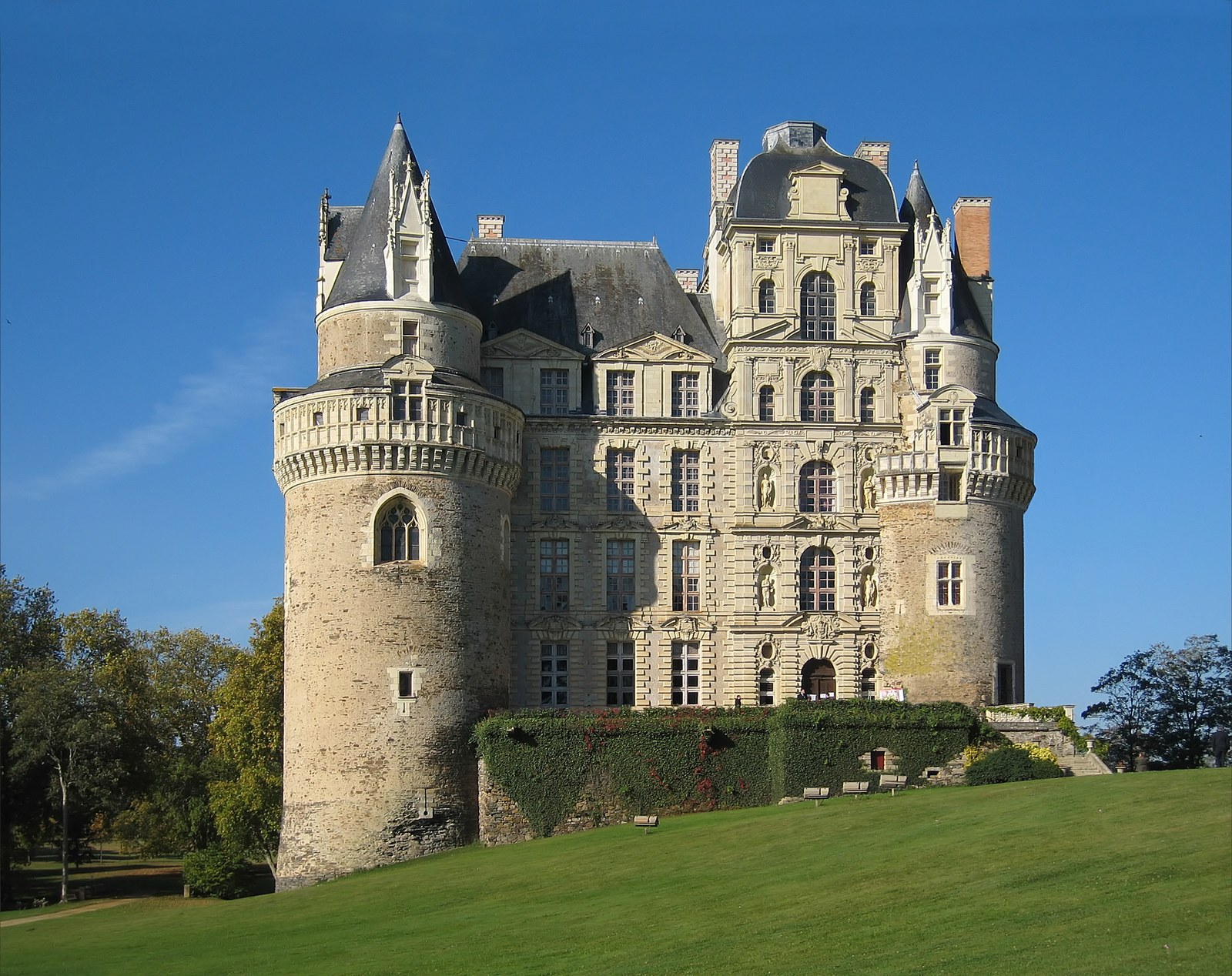
In the hour before dawn, the Loire Valley holds its breath. Mist gathers in the parkland below the Château de Brissac, and the great stone pile stands dark against a paling sky, its seven storeys stacked like a small town that decided to grow upward instead of outward. It is in this hour, according to the stories told by guides and guests for generations, that a figure is sometimes seen in the chapel tower: a woman in a green dress, moving without hurry through rooms that have belonged to one family for more than five centuries. Whether she is there or not, the château itself is real enough, and its history is stranger than any ghost story.
The Giant of the Loire
The Château de Brissac stands at Brissac-Quincé, in the commune of Brissac Loire Aubance in Maine-et-Loire, south-west of Angers. It is known as the “Giant of the Loire Valley,” and the nickname is earned. With seven storeys, it is the tallest château in France. Its façade mixes the rough stone of a medieval fortress with the ordered elegance of seventeenth-century Baroque architecture, and it holds around 204 rooms. From the lawns below, the building seems to lean over the visitor, all towers and tall windows, a castle that grew into a palace without ever quite letting go of its fortress roots.
The site has been fortified since the eleventh century, when it was a castle of the Counts of Anjou. After King Philip II of France defeated the English in the region, the property passed to Guillaume des Roches. It was in the fifteenth century that the château took on something like its present identity, rebuilt by Pierre de Brézé, a wealthy chief minister to King Charles VII. Brézé’s name would become bound to the château in a darker way, too, but in his own lifetime he was a builder, not a ghost.
A Castle Rebuilt from Ruin
The château’s second great transformation came out of war. During the French Wars of Religion, the fortress was seized in 1589 by the Protestant leader Henry of Navarre. It was severely damaged in the fighting and was scheduled to be demolished. What saved it was a change of allegiance. Charles II de Cossé sided with Henry of Navarre, who was soon crowned King Henry IV of France. In gratitude, the king gave Cossé the property, the noble title of Duke of Brissac, and the money to rebuild the château in 1611.
The rebuilding is what made Brissac the tallest château in France. The new work rose inside and above the remains of the old fortress, keeping the medieval towers at the corners while stacking storey upon storey of Renaissance and Baroque rooms between them. The result is a building that looks assembled from two different centuries, because it was. The old towers still stand guard, but the heart of the château is a seventeenth-century palace.
The château has played its part in the history of France beyond its own walls. In August 1620, King Louis XIII and his mother, Marie de Medici, met at Brissac to discuss their differences, and a temporary truce between them was reached there. It did not last, and the Queen Mother was eventually banished, but for a brief moment the château was neutral ground in a quarrel at the very top of the kingdom.
The Family That Never Left
The Cossé family has owned the Château de Brissac since 1502, when René de Cossé acquired it during the reign of King Francis I. Few great houses in France can claim such continuity. Through marriage the family also acquired the Château Montreuil-Bellay, which they later sold, but Brissac itself they kept.
The Revolution nearly ended that long ownership. In 1792 the property was ransacked, and the château lay in waste until a restoration programme began in 1844, carried on by successive Dukes of Brissac. The building was listed as a monument historique by the French Ministry of Culture in 1958 and again in 1966. Today it is still owned by the Cossé-Brissac family and managed by Charles-André de Cossé, the 14th Duke of Brissac, the elder son of François de Cossé, the 13th Duke, who died in 2021.
The château is open to the public for tours, and guests can stay overnight in its guest rooms. Its gilded theatre hosts the annual Val de Loire festival. In the mid-1990s it even served as the setting for the French battles of the original Japanese television show Iron Chef, with two contests staged in its rooms and broadcast in Japan in April 1996. A house that has survived siege, revolution and neglect has learned to welcome strangers.
The Green Lady
All of that history, however, is not what most visitors ask about first. They ask about the Green Lady, La Dame Verte.
According to the legend, she is Charlotte de Brézé, the daughter of King Charles VII and Agnès Sorel, who married Jacques de Brézé, the son of Pierre de Brézé, the man who rebuilt the château. In 1477, the story goes, Jacques discovered his wife with her lover, Pierre de Lavergne, and killed them both. The murder is a matter of historical record. The haunting is not. Legend says that Charlotte’s spirit remained at Brissac, and that she is seen in the chapel tower, most often in the early hours of the morning, wearing the green dress she was said to be wearing when she died.
There is a complication in the story, and it is worth stating plainly. Some historical accounts place the 1477 killings not at Brissac but at Rouvres, near Dourdan, some distance away. If that is correct, then the ghost’s connection to Brissac rests on tradition rather than on the documented location of the murder. The château’s own telling, and the popular version repeated in guidebooks and travel writing, keeps Charlotte at Brissac. The discrepancy is part of what makes the legend a legend: a real death, a real woman, and a haunting attached to a place that may or may not be where she died.
What is reported, by those who claim to have encountered her, is consistent in its details. The figure is described as a woman in green, sometimes said to have no eyes, moving through the chapel tower and the rooms around it. Guests who have stayed overnight in the tower rooms have reported moaning sounds before dawn and a sense of being watched. Others report nothing at all, which is also part of the pattern of such stories: the Green Lady appears on her own schedule, or not at all.
A House That Keeps Its Secrets
Part of the château’s power as a haunted place is that it does not need the ghost to be frightening. The building itself does much of the work. Its corridors are long, its staircases are steep, and its oldest towers still carry the feel of a fortress. At night, when the tour groups have gone and the public rooms fall quiet, a seven-storey house full of old furniture and older portraits is an easy place to imagine footsteps that are not your own.
The Green Lady has become part of the château’s identity in the same way its height and its theatre have. Guides tell her story as a matter of course, and visitors arrive already half expecting to see her. That expectation shapes what people report. A cold draught in an old tower, a creak in a corridor, a shadow at the edge of vision: in an ordinary house these are nothing, but in a house with a famous ghost they become evidence. This does not mean the reports are invented. It means they are difficult to separate from the story that surrounds them.
What can be said with confidence is that the legend has endured for centuries, that it is tied to a genuine fifteenth-century murder, and that it continues to draw visitors to Brissac who might otherwise never have heard of the tallest château in France. The Green Lady, real or not, has kept the château famous.
Closing Reflection
The Château de Brissac is worth visiting with or without its ghost. It is a rare thing: a great house that survived war, revolution and ruin, and is still lived in by the family that has owned it for more than five hundred years. Its towers and its seven storeys tell the story of France in stone, from the Counts of Anjou to the Dukes of Brissac, from a medieval fortress to a Baroque palace.
And if, in the hour before dawn, a guest in the chapel tower thinks they see a woman in green, the château will not argue. It has kept her secret for a very long time. Perhaps the most honest way to put it is this: Charlotte de Brézé lived, and she died violently in 1477, and her name is still spoken in the house her family once owned. Whether she walks there is a question the stones have never answered.
What is documented — and what is not
Documented: The château’s origins as an eleventh-century castle of the Counts of Anjou; its fifteenth-century rebuilding by Pierre de Brézé; its acquisition by René de Cossé and the Cossé family’s ownership since 1502; its seizure and damage in 1589, and its rebuilding in 1611 funded by Henry IV after Charles II de Cossé received the dukedom; the August 1620 meeting of Louis XIII and Marie de Medici; the ransacking in 1792 and restoration from 1844; its listing as a monument historique in 1958 and 1966; its seven storeys and status as the tallest château in France; its current ownership by Charles-André de Cossé, 14th Duke of Brissac; and the 1477 killing of Charlotte de Brézé and Pierre de Lavergne by Jacques de Brézé.
Not documented: That Charlotte’s ghost haunts the château; that she appears in the chapel tower in the early morning; that she wears a green dress; and that the 1477 killings took place at Brissac itself — some accounts place them at Rouvres, near Dourdan. The figure’s appearance, including the detail that she has no eyes, comes from legend and visitor reports, not from any verified record. No scientific evidence has established that the château is haunted.