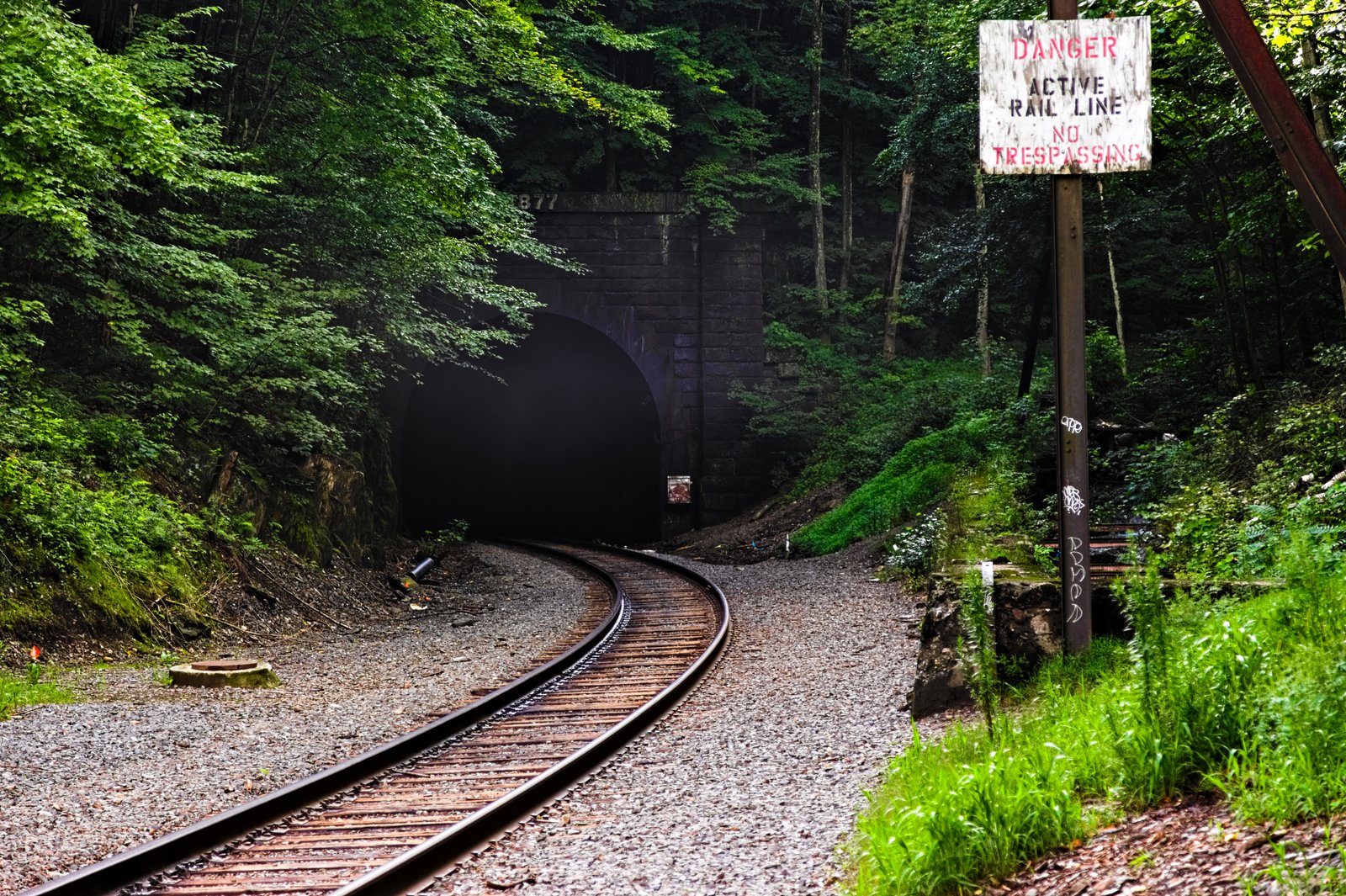
In the Berkshire Mountains of western Massachusetts, a railway tunnel runs for 4.75 miles through solid rock beneath Hoosac Mountain. It is an engineering marvel and a working railway, carrying freight trains to this day. It is also, by reputation, one of the most haunted places in America. The workers who built it called it the Bloody Pit, and the name was earned. Between 1851 and 1875, when the first train finally passed through, 195 workers were killed or seriously injured, with 135 deaths verified. The tunnel’s ghosts, if the stories are to be believed, are the men who died building it, still carrying their picks and shovels through the dark.
A mountain in the way
The Hoosac Tunnel was conceived as a shortcut. In the middle of the nineteenth century, the railway from Boston to Albany had to climb over the Hoosac Range, an extension of Vermont’s Green Mountains, by a long and winding route. A tunnel straight through the mountain would save time, money and gradient. The plan was simple. The execution was not.
Work began in 1851, under an estimated cost of two million dollars. It ended in 1875, having cost twenty-one million. The tunnel was dug from both ends at once — from the east portal in the town of Florida, and from the west portal in North Adams — and from a central shaft sunk into the top of the mountain. The rock was hard. The methods, at first, were primitive: hand tools, black powder, and men working in the dark, in water, in air thick with dust and smoke. Later, the project became a testing ground for new technology, including the first large-scale use of nitroglycerin and the Burleigh drilling machine, one of the first pneumatic rock drills. The tunnel was a triumph of engineering. It was also a catastrophe for the men who built it.
The death toll is usually given as 195 workers killed or seriously injured, with 135 verified deaths. The sources disagree on the exact number — a history of 1878 counts 136 lives, a guide of 1891 gives 195, and the National Register nomination of 1973 offers its own figure — but the scale is not in doubt. Men died from explosions, falling rock, and accidents involving ladders and scaffolding. They died in the dark, underground, far from help. The survivors called the tunnel the Bloody Pit, and the name stuck.
The central shaft disaster
The worst day in the tunnel’s history came in October 1867. The project had sunk a central shaft — a vertical hole, 1,028 feet deep, down through the mountain to the tunnel level — so that men could work outward from the middle as well as inward from the ends. On 17 October 1867, thirteen men were working at the bottom of the unfinished shaft, 583 feet below the surface. Above them, in the hoist building, a candle ignited naphtha fumes leaking from a gasometer. The explosion set the hoist on fire, and it collapsed into the shaft, destroying the pumps and sending burning debris down onto the men below.
The shaft began to fill with water. The thirteen men, trapped in the dark, built crude rafts from timber to stay above the rising water. They lived for hours, possibly days, as the water rose and the air filled with toxic fumes. They died slowly, asphyxiating, waiting for a rescue that could not reach them. Their bodies remained entombed in the watery shaft for over a year before recovery crews could reach them.
Thomas Mallory, a worker who was about to be lowered into the shaft, made out his will before going down. He was pulled back up nearly unconscious from the fumes, and reported that there were no survivors. The central shaft disaster is the single worst event in the tunnel’s history, and it is the one that the ghost stories return to most often. Villagers and workmen told stories of seeing ghostly figures of lost miners wandering through the snow on the mountain, and of wailing near the opening of the central shaft. After the thirteen bodies were found and given proper burials, the sightings were said to stop.
Ringo Kelley
The tunnel’s most famous ghost story is not about the disaster. It is about a murder.
On 20 March 1865, three men — Ned Brinkman, Billy Nash and Ringo Kelley — were working with explosives in the tunnel. Kelley was the explosives expert. A charge of nitroglycerin went off prematurely, and Brinkman and Nash were killed. Suspicion fell on Kelley. Some of the workers believed he had set the charge deliberately, or at least carelessly, and that he had wanted the two men dead.
A year later, to the day, Kelley’s body was found inside the tunnel, about two miles from the entrance. He had been strangled. No one was ever charged with his murder. The workers said the vengeful spirits of Brinkman and Nash had returned from beyond the grave to kill the man who had killed them. The story became one of the tunnel’s most famous legends, and it has been retold in every account of the haunting since.
There is a problem with the story. The letter and the doctor’s statement behind it have not been traced to any printing before 1973, when Yankee magazine carried the tale. No nineteenth-century source mentions Kelley, Brinkman or Nash, and a search of the Library of Congress’s Chronicling America newspaper archive found no trace of them. That does not prove the story is false — the archive is incomplete, and the tunnel’s records are patchy — but it does mean the story cannot be verified. It first appears in print a century after the events it describes.
The headless ghost and the voices
The other famous haunting of the Hoosac Tunnel concerns a headless apparition. In 1872, according to the legend, Dr Clifford J. Owens and the site superintendent James McKinstrey witnessed a headless blue ghost in the tunnel. The figure has become the tunnel’s most famous supernatural resident, and it is said to appear still.
Later reports follow a familiar pattern. Workers and visitors have reported hearing wailing and groans from inside the tunnel, seeing dim lights that appear and disappear as they approach, and hearing voices and laughter. In 1976, a researcher claimed to have seen a figure of a man in old-fashioned work clothes wandering in the tunnel. In 1984, a professor from North Adams State College said that several students had left a tape recorder in the tunnel overnight, and that on returning for it the next day they found several muffled voices on the tape.
The tunnel is still an active railway, and entering it without permission is both dangerous and illegal. That has not stopped people from trying. The tunnel’s reputation as a haunted place draws visitors, and the visitors, in turn, generate new stories. It is a cycle that has been running for a century and a half.
The engineering landmark
For all the ghost stories, the Hoosac Tunnel is, first and foremost, an engineering achievement. The first train passed through it on 9 February 1875, after more than twenty years of work. The American Society of Civil Engineers made it a Historic Civil Engineering Landmark in 1975. It was listed on the National Register of Historic Places in 1973. It remains in use, carrying freight through the mountain, day and night.
The tunnel’s history is also the history of American industrial labour. The men who built it were Irish and Cornish immigrants, working in conditions that would be illegal today, for wages that were low and risks that were enormous. The last death before the opening was that of Orrin Wilson, a fourteen-year-old boy, who was found dead on 20 September 1874 with his head crushed by an elevator. He was fourteen. The tunnel’s ghosts, if they exist, are not only the thirteen men in the shaft. They are the children, the immigrants, and the men whose names were never recorded.
What the stories mean
The ghost stories of the Hoosac Tunnel are, in the end, a way of remembering. The tunnel cost nearly two hundred lives, and the men who died were, for the most part, forgotten by history. The stories keep their names alive — Brinkman, Nash, Kelley, Mallory, Wilson — and they keep the cost of the tunnel visible. A railway tunnel is an abstraction. A ghost, carrying a pick through the dark, is not.
The stories also have a suspicious chronology. The hauntings were not reported in the nineteenth century. The first printed accounts date to 1973, a century after the events. That does not make them false, but it does make them folklore rather than testimony. The tunnel’s ghosts were born in the twentieth century, when the tunnel was already a legend, and they have been retold ever since.
Whether the tunnel is haunted is, in the end, a question that cannot be answered. What can be said is that the tunnel is real, the deaths are real, and the stories are real. The men who built the Hoosac Tunnel died in the dark, and the dark has kept their memory ever since.
What is documented, and what is not
Documented facts: The Hoosac Tunnel is a 4.75-mile active railroad tunnel through the Hoosac Range in western Massachusetts. Work began in 1851 and the first train passed through on 9 February 1875, at a cost of $21 million. Accidents during construction killed or seriously injured 195 workers, with 135 verified deaths; survivors called the tunnel the “Bloody Pit”. The deadliest accident was the explosion in the central shaft in October 1867, when thirteen men were trapped 583 feet below the surface and died of toxic fumes. The tunnel is an ASCE Historic Civil Engineering Landmark (1975) and is listed on the National Register of Historic Places. Entering the tunnel is prohibited and dangerous.
Unverified or disputed claims: The ghost stories — the headless apparition, the voices, the wailing, and the murder of Ringo Kelley by the spirits of Brinkman and Nash — cannot be traced to any printing before 1973, about a century after the events, and no nineteenth-century source mentions Kelley, Brinkman or Nash. The claim that the thirteen men in the central shaft built rafts and lived for hours is reported in later accounts but was not recorded at the time. The exact date of the central shaft explosion is given as 17 October 1867 in most sources and 19 October in others. The claim that ghostly sightings stopped after the thirteen bodies were buried is part of the folklore, not a documented fact.