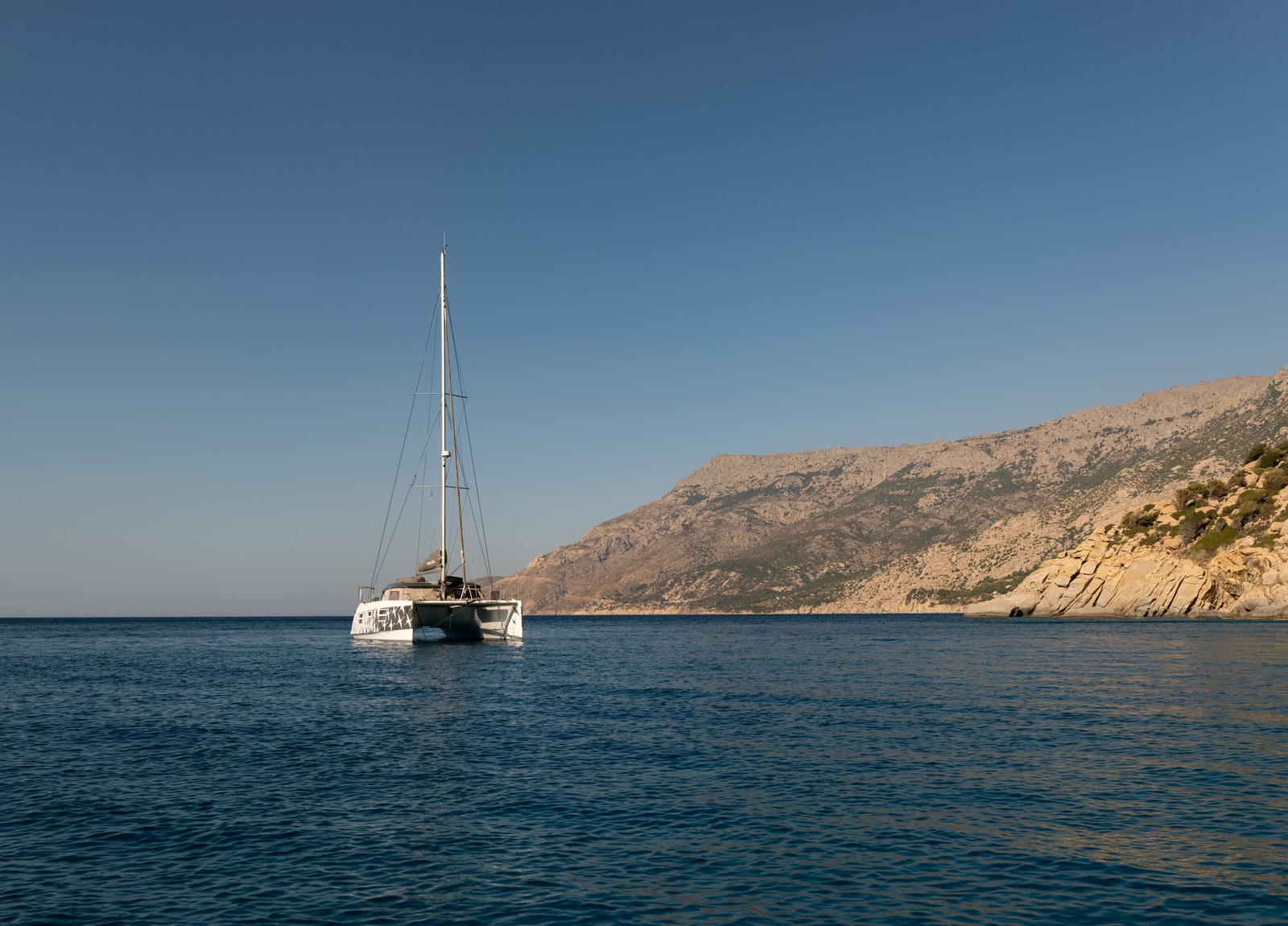
On Friday, 20 April 2007, a rescuer was lowered from a helicopter onto a white catamaran drifting off the Great Barrier Reef. The boat was called Kaz II, a 9.8-metre sailing catamaran, and she was in good order. Her engine was running. Her sails were up. A table was laid for a meal, a laptop sat on the table, and a video camera held footage of her crew, alive and in good spirits, filmed five days earlier. The life jackets were aboard, the emergency beacon was aboard, and the dinghy was aboard. The only thing missing was the crew: three men from Perth, Western Australia, who had set out five days earlier on the first leg of a long voyage home. None of them was ever seen again.
The Kaz II is the modern ghost ship — recent enough that the evidence includes GPS data, video, and a coroner’s inquest — and it is the one that came closest to an answer. The Queensland coroner reconstructed what probably happened, and the reconstruction is widely accepted. But it is still a reconstruction. No one saw the three men go into the water, and their bodies were never found.
Three men, a new boat, and a long way home
The skipper was Derek Batten, 56, widely called Des, a semi-retired carpet layer from Perth. His companions were the brothers Peter Tunstead, 69, and James Tunstead, 63, known as Jim. All three were relatively inexperienced sailors, though Batten had taken a sailing course and had made two extended trips aboard Kaz II around the Whitsunday Islands and the outer reef. Batten had bought the catamaran in 2006, and the three men planned to sail her around the north of Australia to Western Australia — a long coastal passage home.
They set out from Airlie Beach on Sunday, 15 April 2007, bound for Townsville on the first leg. The morning was ordinary enough that Jim Tunstead filmed it: at 10:05 a.m., the camera showed Batten at the helm and Peter Tunstead sitting on the aft stairway, fishing, while the men talked about speed, conditions, and a heavy storm cloud on the horizon. The GPS data showed the boat being steered to the north-east that morning, into an area where squalls and rough seas were building. By late afternoon on the same day, the GPS showed her adrift.
The first indication that something was wrong came on Wednesday, 18 April, when a helicopter reported a catamaran adrift near the reef with her crew possibly in distress. A Coastwatch aircraft had noticed her at 3:45 p.m., moving east across the sea with her headsail torn and no one visible on deck. Two days passed before anyone reached her. On 20 April, maritime authorities caught up with the boat about 88 nautical miles — 163 kilometres — off the north-eastern coast, and boarded her. Queensland’s Emergency Management office described the circumstances as “strange”, and the word was accurate: everything was normal, except that there was no sign of the crew.
What the rescuers found
The details recorded by the boarding party have been repeated in every account since, because they are the whole mystery in miniature. The engine was running. The sails were up, though the headsail was badly shredded. A table was laid for a meal, with food on it. Clothes were laid out, beds looked as though they had been slept in, and a half-full coffee cup stood on the table. The laptop was on. The life jackets were still aboard, the emergency beacon was still aboard, and the dinghy was still aboard. The only signs that were out of the ordinary, other than the disappearance of the crew, were the torn sail and the absence of the life raft — and it is not known whether a life raft was ever aboard.
On Friday, 20 April, the Kaz II was towed into Townsville for forensic examination. On 21 April, police searched the ship for signs of foul play or third-party involvement and found none. A survival expert, Dr Paul Luckin, advised that men in the water had probably gone overboard three or four days earlier. The air and sea search for the three crew members was called off at 4 p.m. on 21 April, and a final coastline sweep ended on 25 April. Nothing was found.
The inquest: one man overboard
On 4 August 2008, an inquest into the men’s disappearance began in the Townsville Coroner’s Court, led by Queensland State Coroner Michael Barnes. The inquest considered whether the men were dead, the circumstances of their disappearance, and whether the search had been adequate. Detective Sergeant Graham Patch told the inquest that there was nothing whatsoever to suggest the men had staged their disappearance, and both the authorities and the families rejected the staged-escape theory.
The coroner’s finding, delivered in August 2008, was that Derek Batten, James Tunstead, and Peter Tunstead were dead, and that they had died in the sea off George Point on 15 April 2007. His reconstruction was a chain of small accidents: one man fell overboard, another tried to help him, and then the final sailor attempted to turn an already moving vessel back toward them. None of them were good swimmers, the seas were choppy, and the men would quickly have become exhausted and sunk beneath the waves. The report ruled out foul play and staged disappearance, and drowning was considered the most likely cause of death.
It is a persuasive reconstruction, and it fits the evidence — the torn sail, the drifting boat, the absence of the life raft, the timing of the GPS track. It is also, as the coroner’s own report makes clear, a reconstruction rather than an eyewitness account. The last confirmed moment is the video at 10:05 a.m. on 15 April. What happened between that footage and the moment the GPS showed the boat adrift that afternoon is inferred, not observed. The bodies were never recovered, and the exact order of events still rests on that inference.
Why the case endures
The Kaz II endures because it is a ghost ship with a modern paper trail, and the paper trail makes the mystery sharper rather than duller. The Mary Celeste left almost no evidence. The Kaz II left a video camera, a GPS log, a laptop, and a coroner’s report — and still the three men are gone without a witness. The case is often compared to the Mary Celeste, and the comparison is fair in one respect: both boats were found in working order with their crews simply absent. But the Kaz II is different in the way that matters most. We know, to within a few hours, when the men were last alive, and we know, from the coroner, the most likely way they died. What we do not know is the moment itself — the wave, the slip, the decision — and that moment is the whole story.
What is documented, and what is not
Documented facts: Kaz II was a 9.8-metre catamaran that departed Airlie Beach on 15 April 2007, bound for Townsville on the first leg of a voyage around northern Australia to Western Australia. Her crew were Derek Batten, 56, Peter Tunstead, 69, and James Tunstead, 63, all residents of Perth. The last video footage, filmed by James Tunstead at 10:05 a.m. on 15 April, shows Batten at the helm and Peter Tunstead fishing. GPS data showed the vessel adrift by late afternoon on 15 April. She was spotted by aircraft on 18 April and boarded on 20 April, about 88 nautical miles off the north-eastern coast. The engine was running, the sails were up with the headsail shredded, the table was laid, and the life jackets, emergency beacon, and dinghy were aboard; no life raft was found, and it is unknown whether one was ever aboard. Police found no evidence of foul play. The air and sea search was called off on 21 April. Queensland State Coroner Michael Barnes found in August 2008 that all three men had died in the sea off George Point on 15 April 2007, most likely by drowning.
Unverified or disputed claims: The coroner’s sequence — one man overboard, the others lost trying to rescue him — is a reconstruction from the GPS track, the torn sail, and the condition of the boat, not an eyewitness account, and the exact order of events is not established. Claims that the men staged their disappearance were examined at the inquest and rejected by the authorities and the families. Popular accounts sometimes say the dinghy was missing; contemporary reports state the dinghy was aboard. The fate of the men’s bodies is unknown, as none were ever recovered.