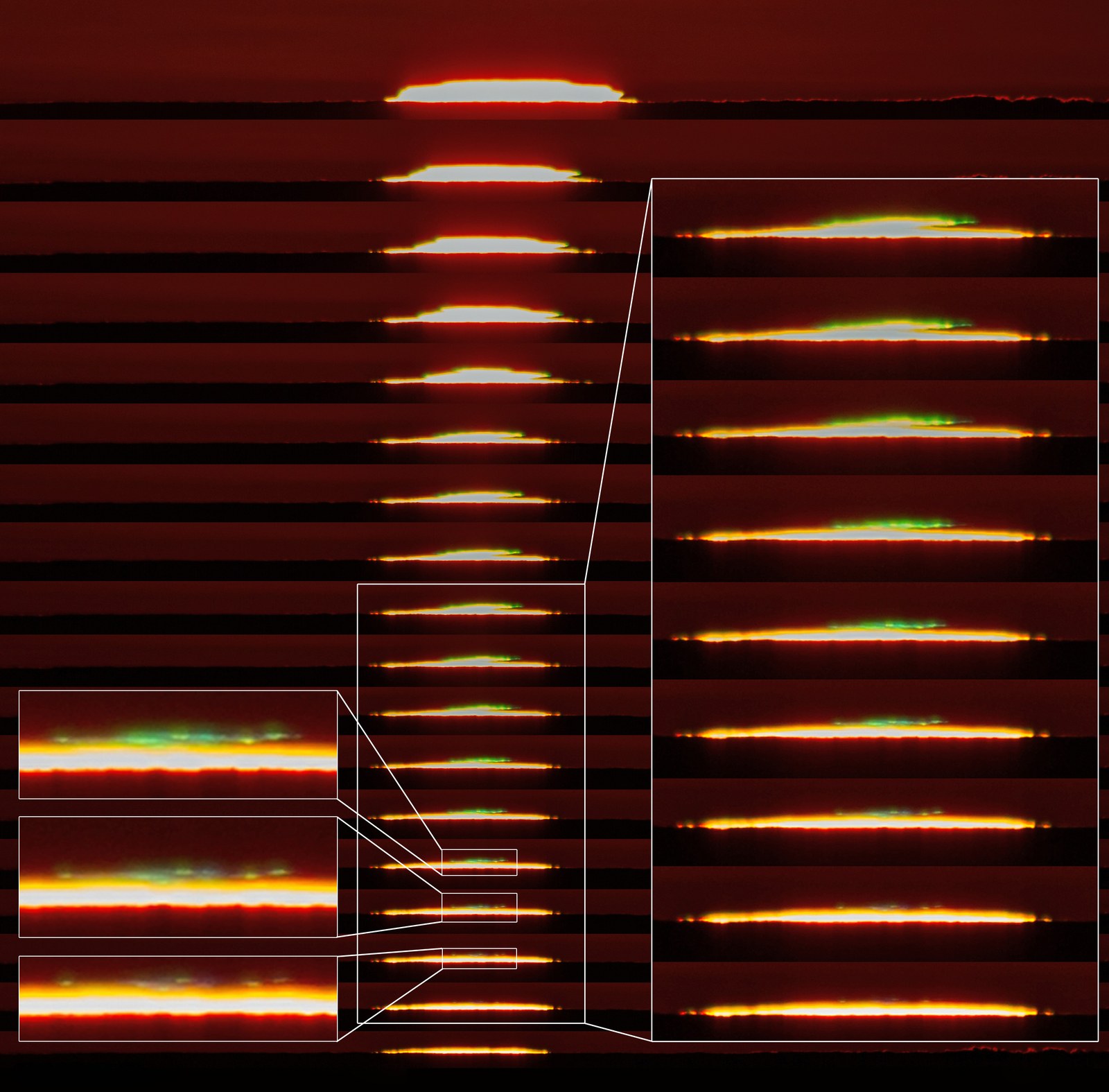
There is a moment at sunset, just as the last sliver of the Sun touches the sea, when the light can do something impossible. For one or two seconds, the top edge of the dying Sun turns a vivid, almost electric green — a colour so pure and so unexpected that the people who first described it were not believed. Sailors swore they had seen it. Poets wrote about it. And for decades, scientists argued that it could not possibly be real, that it was a trick of tired eyes. They were wrong. The green flash is real, it has been photographed many times, and its explanation is one of the prettiest pieces of physics in the whole sky.
A colour no artist could mix
The green flash did not gain public attention until 1882, when it appeared as an important topic in the Jules Verne novel Le Rayon Vert — The Green Ray. Verne waxed floridly poetic about the colour, describing it as “a most wonderful green, a green which no artist could obtain on his palette, a green of which neither the varied tints of vegetation nor the shades of the most limpid sea could ever produce the like! If there is a green in Paradise, it cannot but be of this shade, which most surely is the true green of Hope.”
Verne’s novel follows a heroine who travels in search of the phenomenon, and it turned a sailor’s tale into a fashionable quest. Folk tradition added its own promise: seeing a green flash meant you would never again misread a heart. Much later, the Pirates of the Caribbean films framed it as the sign of a soul returning from the dead. But long before Verne, the flash was already part of the lore of the sea. It was most often reported by sailors, who watched the Sun set over an unobstructed ocean horizon night after night, and who had the patience — and the clear air — to catch it.
The scepticism was understandable. A green Sun sounds like a hallucination, and some scientists of the late nineteenth and early twentieth centuries argued exactly that: the green flash, they claimed, was a complementary-colour afterimage, created by staring too long at the bright setting Sun. The eye, flooded with red and orange, would invent green in response. It was a neat explanation, and it was wrong. Veteran observers pointed out that the green flash could not be an afterimage because it had been seen many times at sunrise, when the green appears before the red of the Sun, not after it. And by the middle of the twentieth century, photographs verified once and for all that the flash was physical, not physiological. Cameras do not have afterimages.
How the atmosphere makes green
The explanation involves two optical effects working together: refraction and dispersion. Sunlight bends — refracts — as it travels through denser layers of the atmosphere, and the effect is greatest at the horizon, where light takes the longest possible pathway through the air. The typical amount of atmospheric refraction at the horizon is about half a degree, roughly the apparent diameter of the Sun itself. That means when we see the Sun’s bottom edge touch the horizon, the Sun’s top edge has really just gone below it. What we see is a refracted image of the Sun, displaced upward by one whole diameter.
But refraction is only part of the story. Sunlight is composed of a range of wavelengths, and each is refracted by a different amount — the shorter the wavelength, the more it is bent. The atmosphere acts like a prism, spreading the Sun’s light into a stack of slightly separated, differently coloured images of the solar disc. Dense air near the horizon spreads sunlight into a rainbow of closely overlapping images, each a different colour from violet to red. The spreading of light according to colour is called dispersion, and it is small enough that most of those images overlap and produce white light — except at the very top and bottom of the solar disc.
Here is where the green comes from. Blue and green, the most strongly refracted colours, stand highest above the horizon and fringe the Sun’s top edge blue-green. Red, the least bent, forms a red fringe at the bottom. As the Sun sets, the red light disappears below the horizon first, and for a brief moment only the green wavelength remains visible at the very top of the disc. The shortest wavelengths — blue and violet — are scattered by the atmosphere so strongly that they never reach your eye at low angles, which is why low sunlight looks warm rather than blue. Green sits in the middle. It bends enough to outlast red and orange, and it scatters less than blue and violet, so for one or two seconds, green is the only colour you see.
A mirage is the second ingredient. A mirage is also necessary for the phenomenon to be seen, because the flash depends on a variation in refraction near the horizon. Cooler, denser air over hot ground — or over the sea — produces a false image of the sky, and the layers of air at different temperatures distort the Sun’s disc, sometimes lifting a sliver of it above the horizon after the rest has set. The combination of the mirage and the dispersion is what produces the flash, and the type of mirage determines the type of flash.
Four kinds of flash
There are four recognised types. The inferior mirage flash, the type usually seen by the naked eye just as the last of the Sun dips below the horizon, is the commonest. The mock mirage flash and the subduct flash depend on different temperature structures in the air. And then there is the green ray — the rarest of all — a beam of green light that shoots up from the green flash or is seen immediately after the Sun sets, like a bright green streak rising from the horizon. What causes the green ray is still unclear; some speculate it may be due to aerosols in the air, but the data is inconclusive because the event is so rare.
Mild versions of the green flash are not uncommon in most climates, and even its most spectacular forms do not necessarily require a sea horizon to observe — though a clear, unobstructed view of the horizon and clean air are essential, which is why green flashes are most commonly seen over water. From high-elevation vantage points, observers have seen green flashes ripple off the top of the setting Sun, distorted by temperature layers in the atmosphere. The famed polar explorer Admiral Byrd claimed to have seen a “green sun” persist for 35 minutes during an expedition to Antarctica — an extreme case of the mirage effect stretching the flash far beyond its usual second or two.
The earliest undisputed scientific record of the green flash was made by a W. Swan, and the great British physicist William Thomson — Lord Kelvin — made reference to Verne’s novel when he wrote of an 1899 sighting of an even rarer phenomenon. The flash has been documented and photographed for over 150 years now, and the astronomer Andrew T. Young of San Diego State University has compiled a comprehensive website of the phenomenon, including photographs of the even rarer blue flash.
Why it still feels like magic
The green flash is filed under “Explained at Last” because it is, in the end, explained. Refraction plus dispersion plus a mirage, in the right air, at the right moment, over a clear horizon. There is no mystery left in the mechanism. And yet the flash keeps its power, because the explanation does not diminish the experience. To stand on a shore at sunset, to watch the Sun sink into the sea, and to see its last light turn a green that no artist could mix — that is a moment that feels like a gift, whether or not you understand the optics. Jules Verne was right about the colour, even if he was wrong about what it meant. The green of the flash is the true green of hope, and it is still there every clear evening, waiting for someone patient enough to watch for it.
What is documented, and what is not
Documented facts: The green flash is a brief optical phenomenon in which the upper edge of the Sun appears intensely green for one to two seconds at the moment of sunset, or more rarely at sunrise. It is caused by atmospheric refraction and dispersion: the atmosphere bends shorter wavelengths (green and blue) more than longer ones (red and orange), so green is the last colour visible at the top of the solar disc; blue and violet are scattered away before reaching the eye. A mirage is also necessary, because the flash depends on variations in refraction near the horizon. There are four recognised types: the inferior mirage flash, the mock mirage flash, the subduct flash, and the green ray. The phenomenon gained public attention through Jules Verne’s 1882 novel Le Rayon Vert (The Green Ray). Early claims that the flash was an afterimage in the eye were disproved by observations at sunrise, where the green appears before the red, and by photographs from the mid-twentieth century onward. The flash is most commonly seen over water with a clear horizon and clean air; Admiral Byrd reported a “green sun” lasting 35 minutes in Antarctica.
Unverified or disputed claims: The exact cause of the rarest form, the green ray — a beam of green light shooting upward after sunset — is still unclear; aerosols in the air have been suggested, but the data is inconclusive because of the event’s rarity. Folk claims that seeing the green flash grants the ability to read hearts, or that it marks a soul returning from the dead, are legends, not facts. The flash does not predict the weather, despite the old saying that glimpsing the green ray means a fine day tomorrow.
Sources
- https://skyandtelescope.org/stargazing-and-observing/celestial-objects-to-watch/catch-the-green-flash/
- https://skyandtelescope.org/stargazing-and-observing/quest-for-the-green-flash/
- https://www.aaas.org/membership/scientia/catching-elusive-green-flash
- https://scienceline.org/2007/12/ask-hamalainen-greenflash/comment-page-1/
- https://www.space.com/green-flash-earth-sunrise-sunset