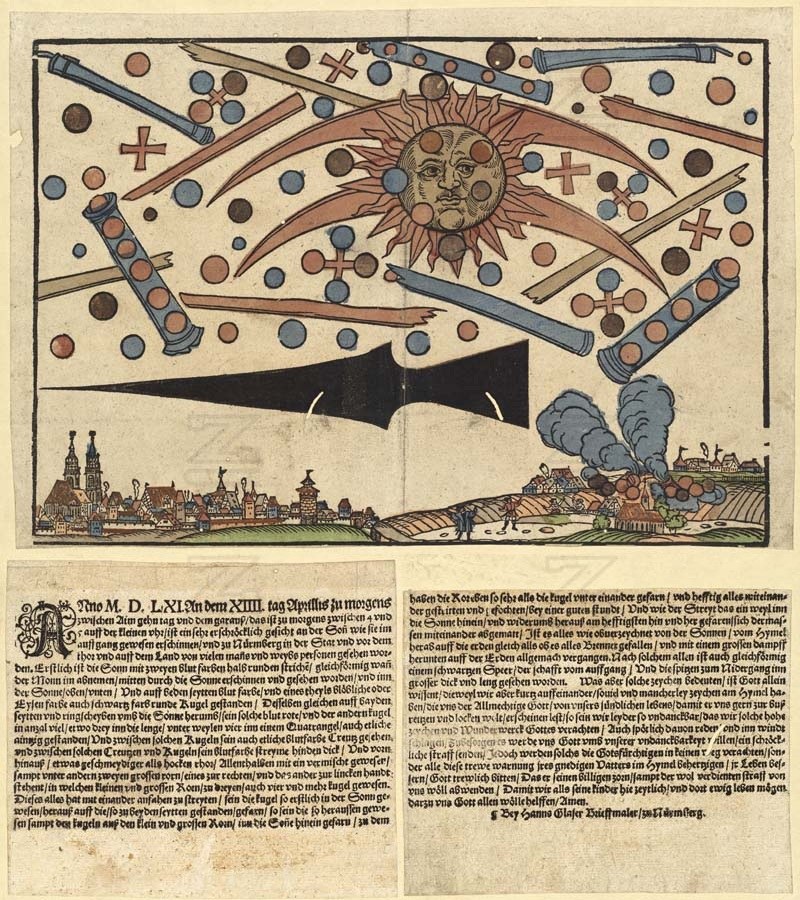
At dawn on 14 April 1561, between four and five in the morning, the people of Nuremberg looked up and saw the sky at war with itself. Above one of the richest cities of the Holy Roman Empire, shapes appeared in and around the rising sun: spheres of red, blue, and black, blood-red crosses, crescents, and long tubes like cannon barrels, from which smaller round objects emerged and darted about. The display lasted more than an hour. Then, according to the account that survives, the objects fought, grew exhausted, and fell to the earth beyond the city walls in clouds of smoke. It is one of the oldest mass sightings in the UFO record, and it comes with something almost no other early case has: a picture, printed within weeks of the event, that anyone can still examine today.
The broadsheet
The record is a single sheet of paper, 26.2 by 38 centimetres, printed in Nuremberg in April 1561. Its author was Hanns Glaser, a letter-painter and printer who made his living producing illustrated broadsheets — the cheap, single-sheet news of the sixteenth century — for a literate, news-hungry public. Glaser had an interest in signs and wonders, and he published accounts of several unusual sightings in his lifetime. The sheet survives in the prints and drawings collection of the Zentralbibliothek Zürich, in Switzerland, as part of the Wickiana collection, an archive of sixteenth-century news items assembled by the Zurich pastor Johann Jakob Wick.
The woodcut at the top of the sheet is the famous part. A sun with a human face stares out from the centre, ringed by two blood-red semicircular arcs. Around it crowd dozens of spheres, crosses, and long cylindrical tubes. A huge black spear-shaped object cuts across the middle of the sky. Below, the city of Nuremberg is drawn in miniature, with smoke rising from buildings at the right. The text beneath, in Early New High German, describes what the image shows: at daybreak, many men and women saw the shapes appear, fight one another, and fall.
Glaser was not a lone eccentric. Nuremberg was a major commercial and printing centre, and its citizens were among the most literate in Europe. The broadsheet was a commercial product, printed to sell, but it was also a news report in the only form available: a printer recording what his city said it had seen.
What the witnesses described
The broadsheet’s text is specific, and its specificity is part of the case’s power. It describes two large black cylinders from which smaller spheres emerged. It describes the spheres as red, blue, and black, and says they fought among themselves for more than an hour. It describes crosses and crescents in the sky. It describes a great black spear that appeared and then vanished. And it describes the ending: the objects fell to earth in smoke, “as if” consumed, and were seen no more.
The account also carries a religious frame that modern readers sometimes miss. Glaser’s text ends with a warning: the phenomenon should be taken as a sign from God, a call to repentance. In 1561, strange things in the sky were routinely read as divine warnings, and printers sold broadsheets partly because readers wanted to know what God was saying. That does not make the sighting invented. It means the document was written in the language of its time, where a strange sky and a moral warning belonged in the same paragraph.
The Basel parallel
Five years later, the same kind of event was reported again, about 200 miles to the southwest. At sunrise on the mornings of 27 and 28 July and 7 August 1566, the citizens of Basel, Switzerland, watched large black spheres appear in the sky, move at great speed, and seem to fight one another before turning red and fiery and falling to earth. The event was recorded in a second illustrated broadsheet, printed by Samuel Apiarius with text by Samuel Coccius, and it too survives in the Wickiana collection.
The parallel is what makes the Nuremberg case hard to dismiss as a single misprint or a single printer’s invention. Two cities, five years apart, described the same kind of display — dark spheres in apparent combat, objects falling — and both produced illustrated broadsheets within weeks. Either the same kind of rare sky event occurred twice, or the second broadsheet copied the first. The Basel broadsheet’s text is independent enough, and its details different enough, that most historians treat the two as separate reports of separate events.
Carl Jung and the modern afterlife
For three centuries, the Nuremberg broadsheet sat in archives, known mainly to historians of print. It entered the modern UFO conversation through the Swiss psychologist Carl Jung. In his 1958 book “Flying Saucers: A Modern Myth of Things Seen in the Skies”, Jung reproduced and discussed Glaser’s broadsheet, treating it as evidence that the human mind has long projected meaningful shapes onto the sky. Jung was not arguing that alien spacecraft visited Nuremberg in 1561. He was arguing that the saucer, like the mandala, is an ancient symbol, and that the Nuremberg sighting showed the symbol appearing long before anyone had a word for it.
UFO writers took the broadsheet further. From the 1960s onward, the Nuremberg image became one of the most reproduced pictures in UFO literature, usually captioned as an “aerial battle” witnessed by an entire city. The image’s power is real: it is a contemporary picture, made by a named person, within weeks of the event, showing objects that look, to a modern eye, like spacecraft fighting in the sky.
What the sky can do
The sceptical case rests on atmospheric optics. The sun, when low on the horizon, can produce a whole family of strange effects: sun dogs, halos, arcs, and mock suns, in which ice crystals in high cloud bend and reflect sunlight into bright spots, crosses, and arcs around the sun. A complex halo display at dawn can produce exactly the kind of thing Glaser’s woodcut shows — bright spots arranged around the sun, coloured arcs, and elongated shapes. The “blood-red arcs” in the broadsheet match the red-tinged arcs of a halo display. The “spheres” match sun dogs and other bright spots. The “cylinders” match the vertical pillars of light that can appear above and below the sun.
The duration fits too. Halo displays can persist for an hour or more, shifting slowly as the sun rises and the ice crystals move. And the “falling to earth in smoke” fits the way a halo display fades as the sun climbs and the cloud layer thins: the bright spots dim and seem to sink.
There is a counter-argument. Halo phenomena are common, and sixteenth-century Europeans saw them often; they had a vocabulary for them. The broadsheet’s witnesses described shapes that fought and moved at speed, which is not how a halo behaves. But a woodcut is not a photograph, and Glaser was an artist working in a tradition that dramatised its subjects. The image may show a real halo display rendered as a battle, with the printer’s imagination supplying the motion and the combat.
There is also the question of why, if this was an ordinary halo, the citizens of Nuremberg were frightened enough to treat it as a divine warning. The answer may be that ordinary is a modern judgement. In 1561, any unusual display in the sky was news, and any news from the sky was read as a message.
Why the case still matters
The Nuremberg phenomenon matters for three reasons. First, it is documented in a dated, attributed, surviving contemporary source, which is more than can be said for most pre-modern sightings. Second, it has a parallel five years later in Basel, which makes it harder to explain away as one printer’s fantasy. Third, it shows how a sighting becomes a legend: a real event, a vivid picture, a religious frame, three centuries of obscurity, and then a famous psychologist’s book that hands the image to a new audience with a new meaning.
What the people of Nuremberg actually saw on the morning of 14 April 1561 will never be settled by argument alone. The broadsheet tells us what they said they saw, and what their printer thought it meant. The sky that morning was doing something unusual enough to frighten a city and to make a printer reach for his woodblocks. Four hundred and sixty-five years later, the picture still does its work: it makes the viewer look up and wonder what was really there.
What is documented, and what is not
Documented facts: A broadsheet by Hanns Glaser, printed in Nuremberg in April 1561, describes a mass sighting at dawn on 14 April 1561, with spheres, crosses, crescents, cylinders, and a large black spear-like shape visible for over an hour. The sheet measures 26.2 by 38.0 cm and is archived at the Zentralbibliothek Zürich in the Wickiana collection. A second, similar broadsheet records black spheres over Basel in July and August 1566, printed by Samuel Apiarius with text by Samuel Coccius. Carl Jung discussed the Nuremberg broadsheet in “Flying Saucers: A Modern Myth of Things Seen in the Skies” (1958).
Unverified or disputed claims: The claim that the objects were spacecraft engaged in an aerial battle is a modern interpretation, not stated in the broadsheet, which frames the event as a divine sign. The claim that the shapes were solid objects rests on a woodcut illustration, not on a photograph or a measurement, and sixteenth-century broadsheets routinely combined observation with religious symbolism and artistic exaggeration. The atmospheric explanation — a complex halo and sun-dog display — fits the shapes and the duration, but it cannot be proven after 465 years, and it does not fully account for the witnesses’ descriptions of motion and combat.
Sources
- https://en.wikipedia.org/wiki/1561_celestial_phenomenon_over_Nuremberg
- https://www.thinkanomalous.com/nuremberg-ufos.html
- https://www.ufohistory.online/1500s
- https://thinkaboutitdocs.com/ufo-battle-over-nuremberg-germany-in-1561/