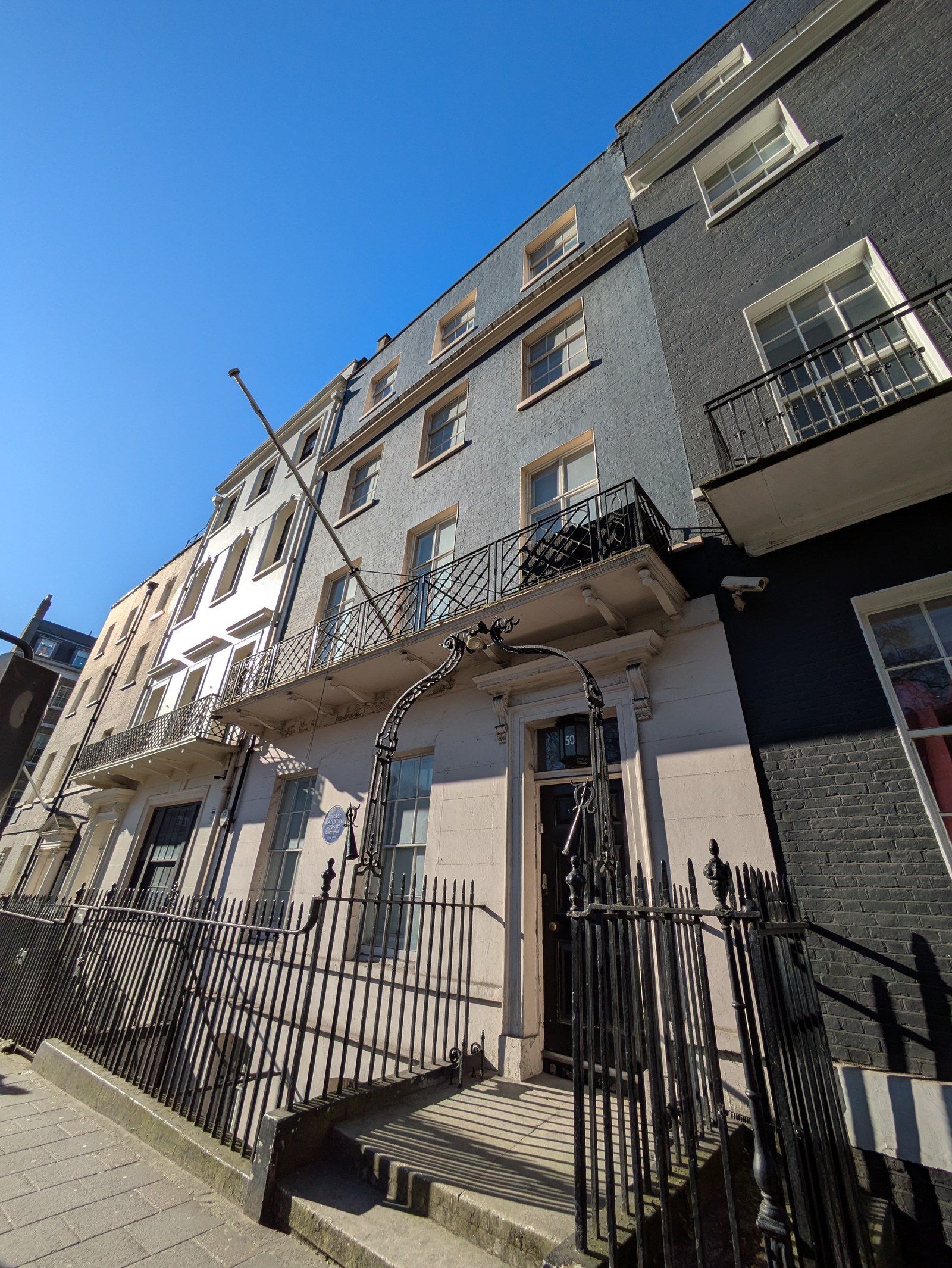
On the western side of Berkeley Square, in the heart of Mayfair, stands a four-storey Georgian townhouse that looks much like its neighbours. Its brickwork is dark, its windows tall and regular, its black front door guarded by iron railings. Nothing about the outside of 50 Berkeley Square announces anything unusual. Yet for well over a century, this ordinary-looking address carried an extraordinary reputation. In the late nineteenth century it was widely called the most haunted house in London, a place where a single night in one attic room was said to be enough to destroy a person’s mind or end their life.
The story is famous. The evidence for it is not. That gap between fame and fact is what makes 50 Berkeley Square worth examining.
A Georgian Townhouse in the Heart of Mayfair
Berkeley Square was laid out in the 1740s as one of the grand residential squares of the West End, and its houses were built for the wealthy and the well connected. Number 50 dates to around 1750, according to Historic England, which describes it as a four-storey house of blackened brick with a stuccoed ground floor. It has been a listed building since 24 February 1958, recorded as Grade II under list entry number 1066467.
Its earliest famous resident was George Canning, the statesman who served briefly as Prime Minister in 1827. He lived at the house until his death that same year, and a blue plaque on the building still records the connection.
Thomas Myers and the House That Fell Silent
For around fifteen years, from 1859 until his death in November 1874, 50 Berkeley Square was occupied by Thomas Myers. He is the one real person at the centre of the legend, and his tenancy is the period in which the house’s reputation began to form.
Popular accounts describe Myers as a man broken by a failed engagement, who shut himself away in grief and let the house rot around him. That romantic version is not supported by the records: researchers who have examined census returns and rate books have found no evidence for the jilted bride or for the claim that Myers went mad.
A grand townhouse standing empty of visitors, its paint peeling and its windows dark, in the middle of glittering Mayfair, was a sight that invited speculation. The haunting may have begun not with anything supernatural but with something entirely visible: a fine house falling apart while its owner lived unseen inside it.
The Attic Room and the Legends That Grew Around It
Almost every version of the legend focuses on the same place: a small room in the attic. The stories attached to it vary wildly, and that variation is itself revealing. In the most common version, the room is haunted by the spirit of a young woman who took her own life there, in some tellings by jumping from the top-floor window after suffering abuse from her uncle. No name, no date and no death record has ever been attached to her.
Other versions tell of different victims: a young man locked in the attic room and fed only through a hole in the door until he went mad and died, or a little girl murdered there by a cruel servant. A further story describes a shapeless brown mist that appears in the room and attacks anyone who spends the night there. These versions cannot all be true, and the contradictions suggest the legend was assembled from separate pieces rather than handed down from a single event.
The tales of named visitors follow the same pattern. In 1879, an article in the Mayfair Magazine alleged that a maidservant who had spent a night in the attic room was found in a state of terror, was taken to an asylum, and died the following day. Other retellings add a nobleman left unable to speak after a night in the room. None of these accounts names a victim whose death can be traced in parish records, newspapers or asylum registers.
The most often repeated story concerns two sailors from HMS Penelope who are said to have stayed a night in the house, usually dated to 1887. The house stood empty only between Myers’s death in 1874 and 1884, when the lease passed to Lord and Lady Selkirk, so a date of 1887 already sits awkwardly with the claim that the sailors stayed in an abandoned house. The story appears to originate with the ghost writer Elliott O’Donnell rather than with any inquest or newspaper report.
Lord Lyttelton, the Shotgun, and Notes and Queries
The earliest solid evidence for the house’s reputation comes not from a ghost but from a journal. In 1872, a correspondent in Notes and Queries, the Victorian journal where readers exchanged historical information and antiquarian puzzles, asked whether a house in Berkeley Square was really believed to be haunted. George William Lyttelton, 4th Baron Lyttelton, responded that such a reputation did indeed exist and identified the property as Number 50. That exchange is the first documented sign that the house was already known locally as haunted.
Lyttelton’s name also appears in a more dramatic story. It is alleged that in 1872, on a bet, he spent a night in the attic room, taking a shotgun with him. During the night, according to the tale, a brown, misty apparition appeared, and he fired at it. In the morning, nothing could be found except the spent cartridges. There is, however, no contemporary record of Lyttelton actually spending the night at 50 Berkeley Square or firing a shotgun inside it.
Dickens, Bulwer-Lytton, and the Literary Afterlife
Charles Dickens is frequently named in popular retellings as having investigated the house. There is, however, no documented evidence that Dickens ever visited or investigated 50 Berkeley Square.
The literary link that does hold up is a different one. Edward Bulwer-Lytton’s short story “The Haunted and the Haunters”, published in 1859, tells of a haunted London house and bears a remarkable resemblance to the stories later told about 50 Berkeley Square. Researchers have suggested that the fiction may have shaped the folklore, or that both drew on the same stock of Victorian ghost-story conventions. Interest in the house was revived in the twentieth century by its inclusion in Peter Underwood’s book Haunted London, published in 1975.
Maggs Bros and the Quiet Decades
The strangest development in the story of 50 Berkeley Square is what happened when the supposedly lethal building returned to ordinary use. In the late 1930s, the antiquarian booksellers Maggs Bros acquired a long lease on the house and turned it into premises filled with rare books and manuscripts. The firm remained at the address for decades, until 2015, and Number 50 became almost as famous among bibliophiles as it had been among ghost enthusiasts.
The expected supernatural catastrophe never arrived. Generations of booksellers worked inside the building without reproducing the dramatic horrors described by Victorian rumour, and the company itself treated the ghost story with dry scepticism, denying that any first-hand accounts of hauntings at the address exist. No phenomena have been reported at the house since the Maggs Bros tenancy began, a silence of more than eighty years — the strongest evidence against the legend.
Why the Story Endures
Why does the legend still circulate, more than a century later? Part of the answer is the setting: the most respectable address in London hiding the most terrifying room in the city. Part of it is the house itself, a genuine Georgian townhouse, which gives the legend a solid anchor in the real world. And part of it is the way the legend was built. It was never a single story told by a single witness, but a collection of stories, each adding a victim, a detail or a famous name, published in magazines and journals over decades until the accumulation itself began to look like evidence. Modern researchers have reached a sober conclusion: the house was never haunted, and many of the stories were exaggerated or invented by later writers, above all by Elliott O’Donnell. The real explanation is simpler and sadder. A lonely man let a fine house fall into ruin, and his neighbours, his city and its magazines filled the empty rooms with ghosts. The house still stands, immaculate now, its dark and derelict days long behind it. What remains is one of the best-told ghost stories in London, and a reminder to ask, of every famous haunting, not only what happened, but who first said so, and how they knew.
What is documented, and what is not
Documented facts: 50 Berkeley Square is a Georgian townhouse in Mayfair, London, dating to around 1750, listed Grade II by Historic England on 24 February 1958 (list entry 1066467). George Canning lived there until his death in 1827 and is commemorated by a blue plaque. Thomas Myers occupied the house from 1859 until his death in November 1874, during which time it fell into visible neglect; in 1873 the parish rate collector sought a warrant against his goods for unpaid rates. In 1872, correspondence in Notes and Queries, including a reply from George William Lyttelton, 4th Baron Lyttelton, identified Number 50 as a house with a reputation for being haunted. The house stood empty from Myers’s death until the lease passed to Lord and Lady Selkirk in 1884. Maggs Bros, antiquarian booksellers, occupied the house from the late 1930s until 2015, and no phenomena have been reported there since.
Unverified or disputed claims: The identities and deaths of the supposed victims — the young woman who took her own life in the attic, the young man locked in the room, the little girl murdered by a servant, the maid who died in an asylum — have no verifiable names, dates or records, and the details vary between tellings. Lord Lyttelton’s alleged overnight stay in the attic with a shotgun in 1872 is not supported by contemporary records. The story of two sailors from HMS Penelope, dated variously to 1843, 1887 or 1943, appears to originate with the ghost writer Elliott O’Donnell rather than with any inquest or newspaper report. Claims that George Canning heard strange noises in the house, and that Charles Dickens investigated it, have no documented basis. The house’s listing grade is Grade II, not Grade II* as sometimes stated.
Sources
- Historic England, “50, Berkeley Square W1” (list entry 1066467) — https://historicengland.org.uk/listing/the-list/list-entry/1066467
- Wikipedia, “50 Berkeley Square” — https://en.wikipedia.org/wiki/50_Berkeley_Square
- Icy Sedgwick, “50 Berkeley Square: The Most Haunted House in London” — https://www.icysedgwick.com/50-berkeley-square/
- Ghosts and History, “50 Berkeley Square: London’s Most Haunted House” — https://www.ghostsandhistory.com/stories/the-most-haunted-house-in-london
- Occult World, “Berkeley Square – London” — https://occult-world.com/fifty-berkeley-square/
- Atlas Obscura, “50 Berkeley Square Townhouse” — https://www.atlasobscura.com/places/50-berkeley-square-townhouse
- The Little House of Horrors, “50 Berkeley Square” — https://thelittlehouseofhorrors.com/50-berkeley-square/