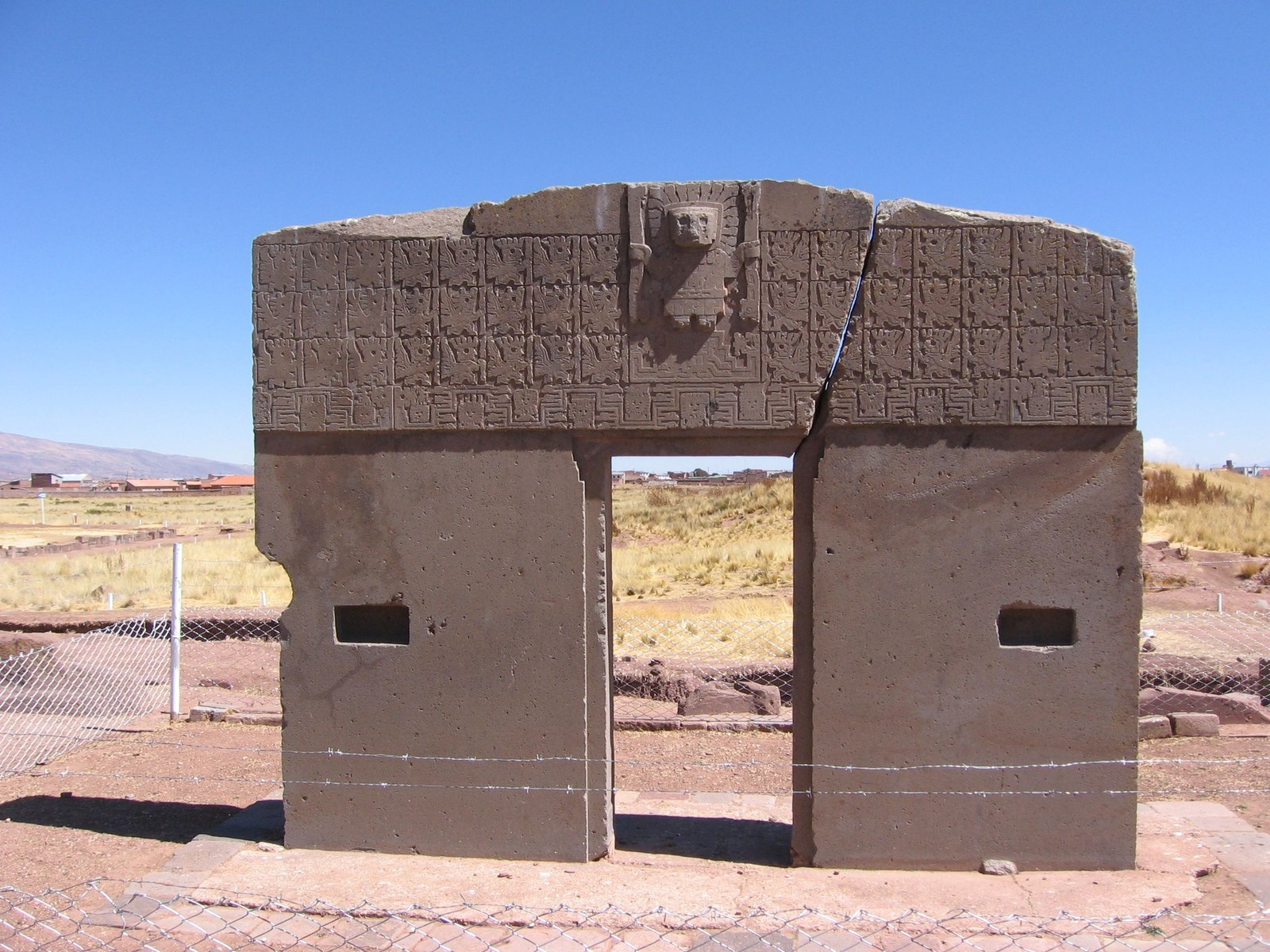
At nearly 3,850 metres above sea level, on the dry, wind-scoured Altiplano of Bolivia, the air is thin enough to make a visitor breathless. And yet here, about 72 kilometres west of La Paz and near the southern shore of Lake Titicaca, a civilisation built a city of stone that dominated the Andes for centuries — long before the Inca Empire existed. Its name was Tiwanaku, also spelled Tiahuanaco, and its ruins still stand in the high, cold light, carved with figures no one can fully explain.
Tiwanaku was the capital of the Tiwanaku Empire between about 200 and 1000 CE. At its largest extent, the empire controlled the Altiplano and stretched from the Peruvian coast to northern Bolivia and into parts of northern Chile. The city itself was laid out on an east-west axis, in a grid design, surrounded on three sides by a moat that linked with Lake Titicaca on the fourth. In Andean mythology, Lake Titicaca was the centre of the world, the birthplace of the sun and moon, and the place where the human race began. Tiwanaku stood at the edge of that sacred water, and it became the spiritual and political heart of an entire world.
The Akapana and the Sacred Precinct
The focal point of the sacred precinct was the Akapana, an artificial hill shaped into a stepped pyramid of seven tiers, more than 15 metres high, with stairways cut into its east and west sides. Built of earth and faced with stone, it was once topped by a temple and a sunken court that may have held water. Centuries of looting — stone was taken for colonial churches and, later, for railway construction in the early 1900s — have left it looking more like an eroded hill than the monument it once was. Even so, it remains one of the largest pre-Columbian constructions in South America.
Beside it stands the Kalasasaya, a rectangular temple platform measuring about 130 by 120 metres, enclosed by standing stones. In its north-west corner stands the most famous object at Tiwanaku: the Gateway of the Sun. Carved from a single massive block of andesite, the gateway is about 2.8 metres high and 3.8 metres wide, and it weighs roughly ten tonnes. Its upper frieze is covered in relief carvings: a central figure, often called the Staff God because it holds a staff in each hand, flanked by 48 smaller winged figures with human or bird heads. The gateway is cracked through its upper right portion, and it does not stand in its original position — it was moved to its present place in the Kalasasaya at some point in the modern era.
The precision of the carving is what draws the eye. The figures are arranged in strict rows, and the stone is cut with a regularity that seems almost mechanical. To the south-west of the main complex, about a kilometre away, lies Puma Punku, meaning “Gate of the Puma” in Aymara. It is a terraced platform mound with a sunken court, but it is famous for something else: its stone blocks. Many of them are cut into precise geometric shapes, including the interlocking H-shaped blocks that have become the site’s signature image. Some blocks are fitted together so tightly that a sheet of paper cannot pass between them.
A Civilisation of Farmers and Traders
Tiwanaku was not only a ceremonial centre. It was a working city, and at its peak, between about 500 and 1000 CE, it may have been home to tens of thousands of people — some estimates put the population at around 20,000. Its people were farmers, and they were remarkably good at it. On the cold, high plain, they built raised fields, known as suka kollus, in the marshy land around Lake Titicaca. The raised beds, separated by canals, stored heat from the sun during the day and protected crops from the night frost. The canals also supplied fish and fertiliser in the form of nutrient-rich mud. With this system, the Tiwanaku grew potatoes, quinoa, and other high-altitude crops in a place where farming should have been marginal.
Trade carried the city’s influence far beyond the Altiplano. Tiwanaku pottery, textiles, and metalwork have been found across the Andes, and its religious imagery — above all the Staff God — appears in the art of other cultures, including the Wari of Peru. Whether this spread was the result of conquest, trade, pilgrimage, or some combination of the three is still debated by scholars. What is clear is that Tiwanaku was the centre of a network that bound together much of the south-central Andes.
The city was founded sometime in the Early Intermediate Period, and the first monumental architecture dates to around 200 CE. From about 375 CE the city grew grander in scale, and the great structures that visitors see today were mostly built from about 400 CE onwards. Tiwanaku was already ancient when the Inca rose to power in the fifteenth century — and the Inca themselves treated it as a sacred place of origins, a ruin left by a greater age.
The First European Description
The first European to describe Tiwanaku was the Spanish chronicler Pedro Cieza de León, who visited the site in 1549, less than two decades after the Spanish conquest of the Inca Empire. He wrote of great stone buildings and statues, and of local people who told him the structures had been built in a single night by a vanished race, or by giants. The story tells us less about who built Tiwanaku than about how the site was already regarded — by the time Europeans arrived, it was a place of legend, its builders forgotten.
Excavation began in earnest only in the twentieth century. In 2000, UNESCO inscribed Tiwanaku on its World Heritage List, recognising it as the spiritual and political centre of the Tiwanaku culture and a key witness to the pre-Inca history of the Andes.
Why Did It Fall?
The Tiwanaku Empire collapsed around 1000 CE. The city was abandoned, possibly as late as about 1100 CE, and the empire dissolved into the Aymara kingdoms that followed. The reasons are still argued. The leading explanation is climatic: evidence from lake sediments suggests that the region suffered a prolonged drought beginning around 950 CE, which would have undermined the raised-field agriculture on which the city depended. Other factors may have played a part — internal unrest, the strain of maintaining a far-flung network, or conflict with neighbouring peoples. The record does not give a single, clean answer.
The drought hypothesis is supported by real evidence, but it is not the whole story, and archaeologists continue to debate how much weight it should carry. What is certain is that a city that had dominated the Andes for eight centuries faded within a generation or two, and that its people did not leave a written account of what happened. Like the builders of Poverty Point, they left only stone.
What Is Known — and What Is Not
Documented facts: Tiwanaku was the capital of the Tiwanaku Empire between about 200 and 1000 CE, located on the Bolivian Altiplano at about 3,850 metres, near the southern shore of Lake Titicaca. Its major monuments — the seven-tiered Akapana, the Kalasasaya (about 130 by 120 metres), the Gate of the Sun (a single andesite block about 2.8 metres high and 3.8 metres wide, carved with 48 figures around a central Staff God figure), and Puma Punku, about a kilometre to the south-west — were mostly built from about 400 CE onwards. The city used raised-field agriculture and traded across the Andes. It was inscribed on UNESCO’s World Heritage List in 2000. It was abandoned around 1000 CE, possibly as late as 1100 CE. Pedro Cieza de León described the ruins in 1549.
Unverified or open to interpretation: The identity of the central figure on the Gate of the Sun is not established; “Staff God” is a modern scholarly label, and the claim that the figure is the god Viracocha is an interpretation, not a documented fact. The idea that the Gate of the Sun functioned as an astronomical calendar dividing the year into ten months is a hypothesis, not a consensus. The exact cause of the empire’s collapse is not settled; drought is the leading explanation, supported by lake-sediment evidence, but it is not proven as the sole cause. Fringe claims that Tiwanaku is tens of thousands of years old, or that its stonework required lost technology or non-human builders, are not supported by archaeological dating or evidence and are not accepted by scholars. The original name of the city is not known; “Tiwanaku” is the name used by later peoples, and the Aymara name Taypikala is a later tradition.
Tiwanaku stands as a reminder that the Andes had a great civilisation long before the Inca, and that its achievements — in stone, in farming, and in art — were made at an altitude where most visitors can barely walk uphill. The Gate of the Sun still faces the sky it was carved to honour, its figures staring out across a plain that has outlasted the empire that raised it.