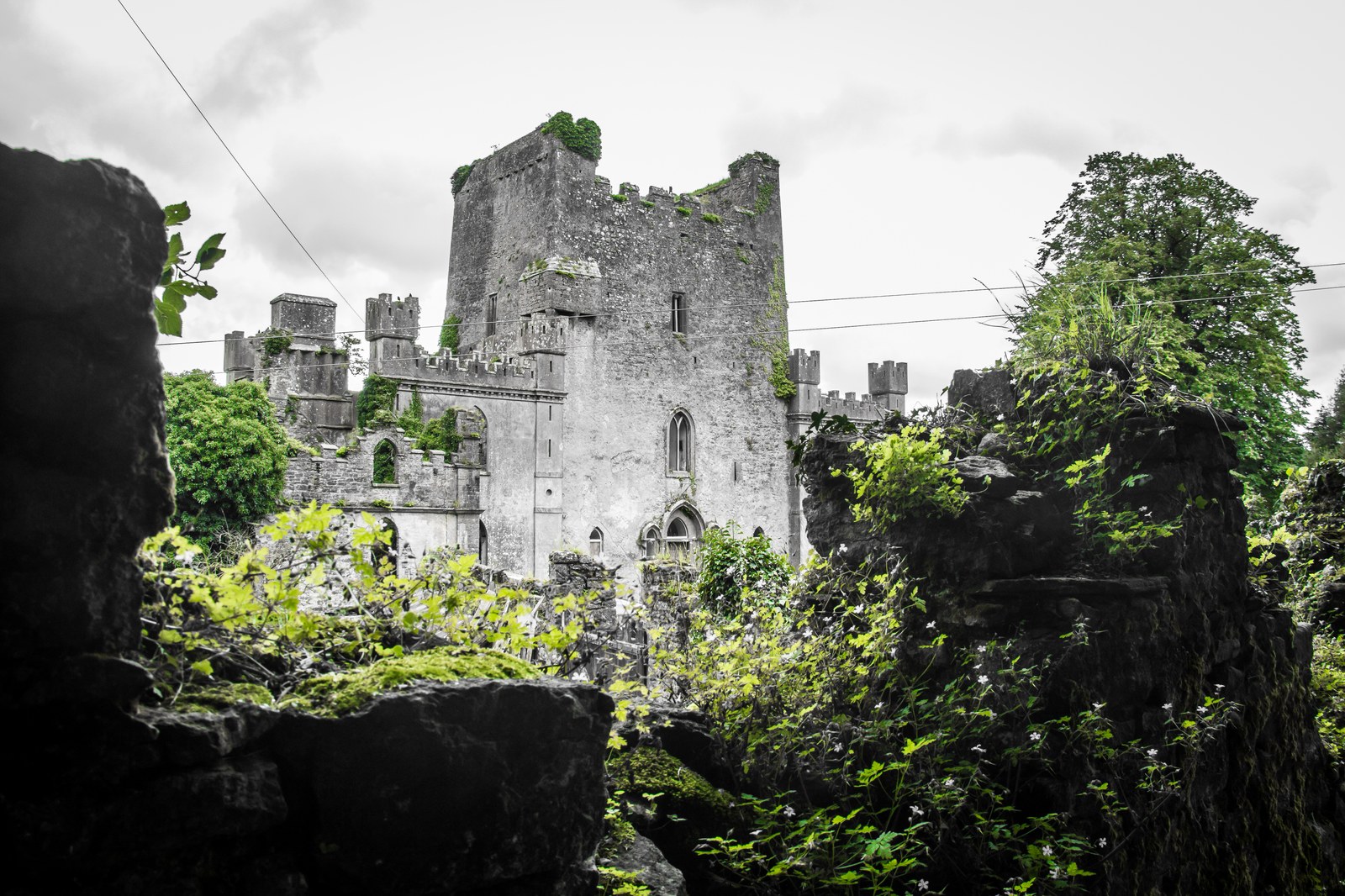
Evening comes early to the high ground between Roscrea and Kinnitty, and the tower seems to gather the last of the light before the fields do. Leap Castle stands on a rise above the R421 in County Offaly, its grey stone keep rising over lower, later wings, its windows narrow and watchful. From the road it looks less like a house than a held breath: a fortress built to see trouble coming, and to survive it.
Few buildings in Ireland have so much documented violence in their past and so many unverified tales attached to it. Untangling the two does not make the castle less interesting, because the real record is strange enough without embellishment.
A tower on disputed ground
The Irish name, Léim Uí Bhánáin, means the Leap of the O’Bannons. According to the most commonly given account, the tower was built by the O’Bannon clan, secondary chieftains under the ruling O’Carroll clan of Ely O’Carroll. The site had been occupied far longer: there is evidence of an older stone structure, possibly ceremonial, and of occupation since at least the Iron Age.
When the main tower was raised is disputed. Accounts range from the thirteenth century to the late fifteenth century, with about 1250 often given as the most likely date, while the state’s archaeological survey reads the surviving tower as later work, from the late sixteenth century. That disagreement is a warning against the confident dates in popular retellings.
The castle’s position explains why it was fought over. It guarded the pass from the Slieve Bloom Mountains into Munster, and it looked out over fertile land worth holding. In 1513, Gerald FitzGerald, Earl of Kildare, tried unsuccessfully to seize it. He attacked again in 1516 and partly demolished it. By 1557 the O’Carrolls had regained possession. Leap was a stronghold in a contested borderland, held by force.
The O’Carrolls and the Bloody Chapel
The O’Carrolls of Ely were powerful, and their internal politics were often violent. The most famous episode in Leap’s history belongs to that world of clan rivalry, and it gave the castle’s upper chapel its enduring name. After the death of Mulrooney O’Carroll in 1532, a fierce rivalry for leadership broke out within the family. One of the brothers involved was a priest. According to the traditional account, he was holding Mass for members of his family in the chapel at the top of the tower when his rival brother burst in, struck him down with a sword, and left him to die across the altar in front of his family. The room has been called the Bloody Chapel ever since.
The names given to the two brothers vary from one retelling to another, so they are best left unsettled here. The Annals of the Four Masters do record an O’Carroll feud in 1532, but the version preserved there describes a killing on the Green of Birr, not a murder at Mass inside Leap. That does not prove the chapel story false. It does show that the most dramatic version comes from later tradition rather than from a contemporary record. The chapel is real, the feud is real, and the name has stuck for centuries.
The oubliette and the bones
Beneath the Bloody Chapel lies the feature that has done most to fix Leap’s reputation: an oubliette, a concealed pit whose name comes from the French word for forgetting. Prisoners, the story goes, were dropped into it and left there, out of sight and out of mind. Popular accounts describe a shaft several metres deep, sometimes lined with spikes, and a clearance that produced cartloads of human bones.
Here the record needs particular care. The bones were not first discovered during renovations in the 1920s, as many modern retellings claim. A published account from January 1898, Mildred Darby’s “A House of Horrors”, already describes the oubliette as known, and says that a couple of cartloads of old bones and bone dust had been cleared from it and buried by an earlier ancestor. The story of bones in the pit predates the burning of the castle in 1922 by more than two decades.
The figure of 150 bodies, often quoted alongside the three cartloads, appears to come from a confusion between two separate stories in that same early account. After the passage about the bones, the text tells a different tale, of 150 mercenaries said to have been killed rather than paid. The number belongs to that second story, not to a count of skeletons. Later writers merged the two, and the merged version has been repeated ever since. There is no surviving excavation report giving a reliable count of the dead or a date for the clearance.
The Darbys, séances and the Elemental
In 1642 the castle passed by marriage to the Darby family, who would hold it for nearly three centuries. Among the Darbys were Vice-Admiral George Darby, Admiral Sir Henry D’Esterre Darby, and John Nelson Darby. The family expanded the keep, raised rents to pay for the work, and sold off much of the accompanying land.
It was under the Darbys, in the late nineteenth century, that Leap’s ghost stories moved from local tradition into print. Jonathan Charles Darby’s wife, Mildred Darby, was a writer of Gothic novels. She held séances in the castle, and she wrote about the place under the pen name Andrew Merry. In January 1898 the magazine Belgravia published her story “A House of Horrors”. In December 1908 the Occult Review reprinted it with changes, and in January 1909 the magazine printed letters she supplied describing further reported sightings.
At the centre of her account was a presence later called the Elemental: a grey, roughly human figure, described as about the size of a sheep, gaunt and shadowy, with a foul smell likened to a rotting corpse. Mildred Darby described feeling a hand on her shoulder while standing on the gallery, and turning to see the figure close behind her. Later explanations have included a Druidic guardian, a leprous O’Carroll, and a spirit awakened by disturbed human remains. None has any source that can be traced to a contemporary record.
What is documented is narrower. The Elemental rests on one named person, a writer of fiction who first published the account as a story told in another voice, and who later claimed a sighting of her own. The supporting letters printed in 1909 were supplied through her, were published without names, and used the substitute names from her story. They are not independent witnesses. The most famous ghost in Ireland’s most famous haunted castle traces back to a single literary source.
Fire, ruin and restoration
The Darby era ended in fire. During the Irish Civil War in 1922, the castle was burned by raiders who gave the occupants twenty minutes to remove a wife and child before setting the building alight. In September 1922 the owner obtained a reinstatement estimate of more than £22,000. The claim was settled for less.
The castle then stood as a ruin for half a century. In 1974 it was bought by Australian historian Peter Bartlett, whose mother had been a Banon, a name connected with the castle’s early owners. Bartlett, working with builder Joe Sullivan, restored it until his death in 1989. Since 1991 the castle has been privately owned by the musician Seán Ryan and his wife Anne, who have continued the restoration. The building visitors see today is not a frozen medieval ruin. It is a tower that has been burned, left open to the weather, and then patiently rebuilt by people who chose to live in it.
Alongside the Elemental, the claims attached to Leap include a Red Lady and the ghosts of two girls, sometimes described as playing in the halls. Visitors have also reported sudden cold, unexplained sounds, and a sense of being watched. Leap has been visited by investigators from television programmes including Most Haunted, Ghost Hunters and Ghost Adventures, and the castle has at times described itself as the world’s most haunted castle. That is a claim about reputation, not a finding of fact. A visitor who arrives already knowing the stories is primed to interpret a draught or a settling timber in a particular way.
A tower that keeps its secrets
Leap Castle endures because it holds two histories at once. One is written in stone and in records that can be checked: a tower on a contested pass, a clan feud in 1532, a transfer of ownership in 1642, a burning in 1922, a restoration that began in 1974 and continues under private owners today. The other is written in stories that began with a Gothic novelist in 1898 and have been retold, enlarged and merged ever since: a chapel named for a killing at the altar, a pit of bones whose numbers will not settle, and a grey, foul-smelling figure on the gallery.
Neither history cancels the other. The documented past explains why the stories took root here. The stories explain why the castle, long after its military purpose ended, is still visited, still written about, and still argued over. Leap does not offer a verdict. It offers a tower, a chapel, a pit beneath the floor, and a question that has lasted for more than a century: how much of what we feel in an old building belongs to the building, and how much belongs to the stories we carried in with us.
What is documented — and what is not
Documented: a fortified tower at Leap, near Roscrea in County Offaly, on ground occupied since at least the Iron Age; O’Bannon builders under the ruling O’Carroll clan; attacks in 1513 and 1516 and O’Carroll repossession by 1557; a family feud after Mulrooney O’Carroll’s death in 1532; transfer to the Darby family by marriage in 1642; Mildred Darby’s “A House of Horrors” published in Belgravia in January 1898 and reprinted in the Occult Review in December 1908; the burning of the castle in 1922; purchase of the ruin by Peter Bartlett in 1974; private ownership by Seán Ryan and his wife Anne since 1991.
Not documented: the exact date the tower was built; the names of the brothers in the Bloody Chapel story and the claim that the killing happened at Mass, which the Annals of the Four Masters do not confirm; the depth of the oubliette, the presence of spikes, the date its bones were cleared, and any count of victims, including the figure of 150; the identity or origin of the Elemental, including the claim that it was a leprous O’Carroll; the Red Lady and the two girls as historical persons; and any verified evidence of haunting.