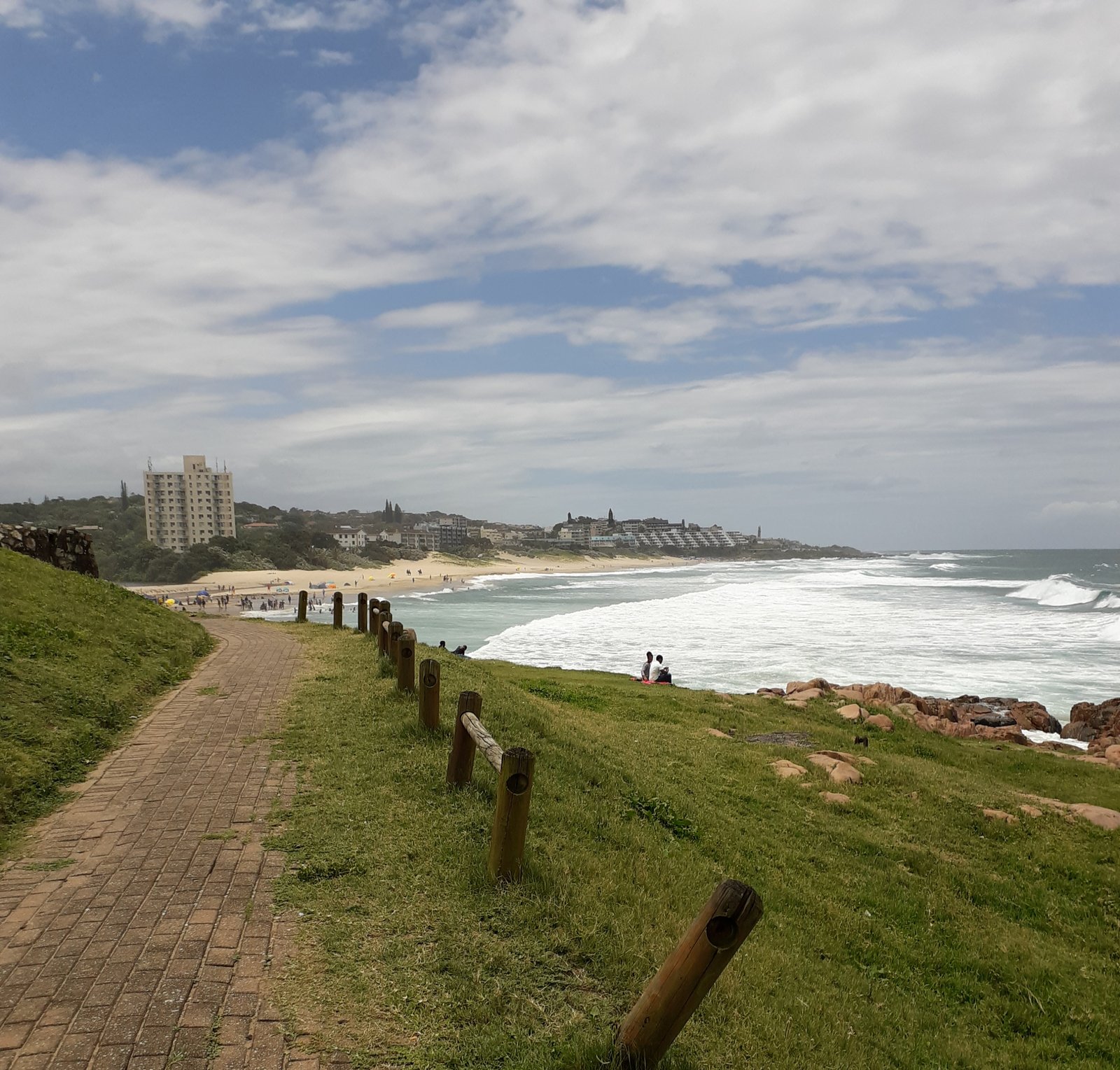
On the morning of 25 October 1924, a farmer named Hugh Ballance was walking along the beach at Margate, a small town on the south coast of what is now KwaZulu-Natal in South Africa. He stopped to watch something in the surf. Two killer whales — orcas — were attacking a huge white creature in the shallow water. The battle went on for three hours. The creature fought back with its tail, at one point rearing up out of the water to a height of about twenty feet. Eventually, exhausted, it floated ashore. It lay on the beach for ten days. No scientist ever examined it. No one took a photograph that was published for eighty-six years. And the creature, when it was finally given a name, was called Trunko — after the trunk.
The battle in the surf
Ballance was not alone. A group of beachgoers watched the struggle with him, and their accounts agree on the broad shape of what happened. Two orcas were attacking a large animal in the surf, and the animal was fighting back. The creature was white, covered in what looked like fur, and enormous. It used its tail to lash at the whales. At one point it lifted itself out of the water, apparently on its tail, to a height of about twenty feet. The whales, according to some accounts, were killed by the creature. According to others, they simply left.
The story reached London two months later. On 27 December 1924, the Daily Mail published an article entitled “Fish Like A Polar Bear”, describing the creature and the battle. The article quoted Ballance’s description of the animal as looking like a giant polar bear, and it set the pattern for everything that followed: a white, fur-covered sea monster, fighting whales, on a South African beach.
The carcass on the beach
When the creature washed ashore, the people of Margate measured it. It was forty-seven feet long, ten feet wide, and five feet high. Its fur was eight inches long. It had a tail ten feet long. And it had, strangest of all, a trunk-like appendage about five feet long and fourteen inches in diameter, attached directly to its torso. There was no visible head. The trunk seemed to grow out of the body itself, with no head at all.
The carcass lay on Margate beach for ten days. Nobody with any scientific training examined it. It was never dissected, never measured properly, never preserved. It was, by all accounts, a popular attraction — people came to look at it, to poke it, to take its measure with a tape. And then, after ten days, it washed back out to sea, or was buried, or rotted away. The accounts differ. What is certain is that no sample of it survives, and no scientific description of it was ever published.
That is the central frustration of the Trunko case. A forty-seven-foot animal, on a public beach, for ten days, in 1924 — and no scientist looked at it. It is a reminder of how different the world was a century ago. Margate was a small town, far from any university or museum. The people who saw the carcass were farmers, fishermen and holidaymakers. They did what they could. They measured it, they described it, and they went home.
The name
The creature had no name for seventy-two years. It was simply the Margate monster, or the polar-bear fish. In 1996, the British cryptozoologist Karl Shuker gave it one, in his book “The Unexplained”. Because of the trunk, he called it Trunko. The name stuck, and it has been used ever since. It is a good name for a mystery: affectionate, slightly absurd, and attached to a feature that no one could explain.
The photographs
Until September 2010, it was assumed that no photographs of Trunko had ever been published. Then, on the website ShukerNature, four photographs surfaced. They had been taken by a local resident named A. C. Jones, in 1924, and kept in a family collection for eighty-six years. They showed the carcass on the beach at Margate.
The photographs were, in a way, a disappointment. They did not show a white-furred monster with a trunk. They showed a shapeless white mass on the sand, covered in long, fibrous material, with no clear anatomical structure at all. It was, to any eye, a lump. A very large lump, but a lump.
The British palaeontologist Darren Naish examined the photographs and wrote about them. His conclusion was blunt. The photographs, he said, show that Trunko was the rotting carcass of a large vertebrate, most likely a whale. The enormous bulk, the large amount of what looks like frayed, badly decayed collagen, and the presence of what seems to be a mostly obscured internal skeletal framework, all point to the same conclusion. Trunko, he wrote, was another globster — a rotting mass of whale tissue. The idea that it was really the body of a white-furred, trunked sea monster, he argued, “stems from naivety about the appearance of rotting animal carcasses”.
What a globster is
A globster is an unidentified lump of flesh, or a decomposed sea creature, that washes ashore. The term was coined in the 1960s by the British biologist Ivan T. Sanderson, from “glob” and “monster”. Globsters typically lack distinct features such as eyes, a head or bones, which makes them difficult to identify. On close examination, they almost always turn out to be dead sharks or whales.
The process is well understood. When a large whale dies and decomposes, the skin and muscle rot away, leaving the blubber and the connective tissue. The collagen fibres in the blubber, as they decay, separate into long, white, hair-like strands. The bones sink or scatter. What is left is a huge, pale, fibrous mass with no recognisable anatomy — a creature with no head, no eyes, and something that looks like fur. If the mass includes a piece of the whale’s jaw or a fold of tissue, it can look like a trunk. A forty-seven-foot whale, rotted for days in the surf, would look exactly like the thing described on Margate beach.
The battle with the killer whales, too, has a natural explanation. Orcas are known to play with dead whale carcasses, tossing them, tearing at them, and feeding on them. What Ballance and the beachgoers saw may well have been two orcas feeding on a dead whale in the surf, and the “battle” may have been the carcass rolling and thrashing in the waves as the whales worried at it.
The case for the mystery
The globster explanation is strong, and it is accepted by most scientists who have looked at the case. But it does not explain everything, and the Trunko story retains a stubborn residue of strangeness.
The first problem is the trunk. A rotting whale can produce a fibrous mass that looks like fur, and a fold of tissue that looks like a trunk. But the witnesses were specific: a trunk five feet long and fourteen inches in diameter, attached directly to the torso, with no head visible. That is a very particular shape, and it was measured, not just glimpsed.
The second problem is the behaviour. The witnesses described the creature rearing twenty feet out of the water on its tail, and fighting the whales for three hours. A dead whale does not rear out of the water. It floats. The orcas may have been playing with a carcass, but a carcass does not fight back.
The third problem is the measurements. Forty-seven feet long, ten feet wide, five feet high. Those are the dimensions of a large whale, and they fit the globster explanation well. But they were taken by beachgoers with a tape measure, on a rotting mass, and they are the only measurements we have. They are consistent with a whale. They are also consistent with something else, and we will never know which, because the carcass is gone.
Why Trunko matters
Trunko matters because it is the best-documented globster in history, and because it shows how a mystery is made. There was a real event: something large and white was in the surf at Margate on 25 October 1924, and something large and white lay on the beach for ten days. There were real witnesses, who described what they saw in good faith. There was a real newspaper report, two months later, that fixed the story in print. And there was a real absence: no scientist, no photograph, no sample, for eighty-six years.
When the photographs finally appeared, they settled the scientific question and left the human question open. The photographs show a globster. The witnesses described a monster. Both are true, in their own way. The witnesses saw a rotting whale, and they described what they saw as best they could, in the language they had. The monster was in the eye, not in the water.
Trunko is a reminder that the sea does not give up its dead neatly. A whale, rotting in the surf, can look like anything, and for ten days in 1924, on a beach in South Africa, it looked like a monster with a trunk.
What is documented, and what is not
Documented facts: On 25 October 1924, Hugh Ballance and other beachgoers at Margate, South Africa, reported two killer whales attacking a large white creature in the surf for about three hours. The carcass washed ashore and was measured by beachgoers at 47 feet long, 10 feet wide and 5 feet high, with a trunk-like appendage 5 feet long. It lay on the beach for ten days and was never examined by a scientist. The Daily Mail reported the story on 27 December 1924 under the headline “Fish Like A Polar Bear”. Four photographs taken by A. C. Jones in 1924 surfaced in September 2010. Karl Shuker named the creature “Trunko” in 1996.
Unverified or disputed claims: The claim that Trunko was an unknown animal with white fur and an elephant-like trunk rests on eyewitness descriptions of a decomposing carcass, and is contradicted by the 2010 photographs, which show a shapeless mass consistent with a rotting whale. The claim that the creature fought the killer whales and reared twenty feet out of the water is not supported by the photographs and is most plausibly explained by orcas playing with or feeding on a dead whale. The claim that the trunk was a real anatomical feature has no supporting evidence; no sample of the carcass survives.