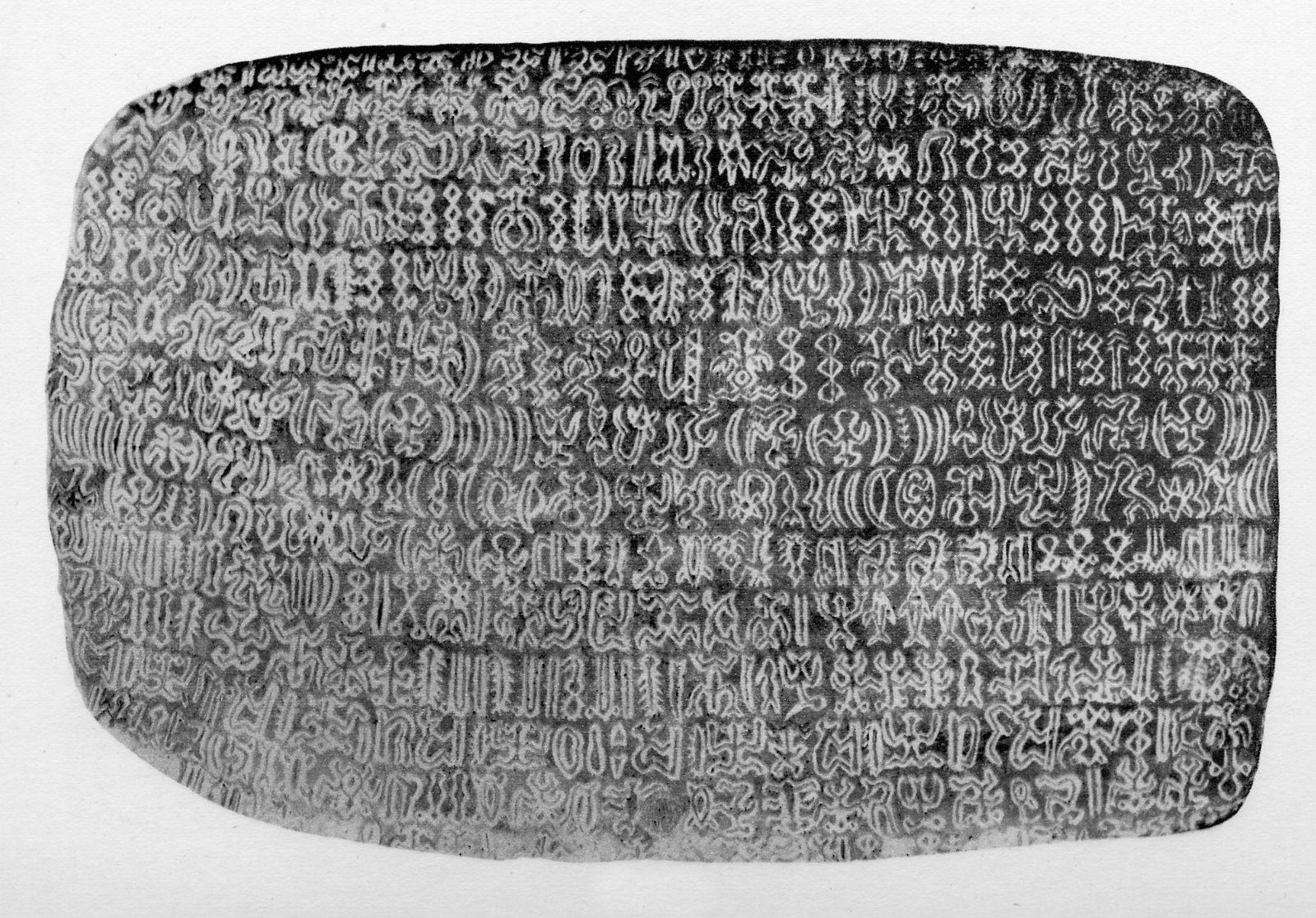
On one of the most isolated inhabited islands on Earth, a people carved a script into wood that nobody alive can read. The signs are small and crowded, shaped like human figures, birds, fish and plants. They look like writing. Yet after more than 150 years of study, not a single sentence of rongorongo has been read with general scholarly agreement. The knowledge of how to read them died with the last people who may have held it, in the 1860s.
A script on the most isolated inhabited island
Rapa Nui, known to outsiders as Easter Island, lies about 3,800 kilometres off the coast of Chile, in the deep Pacific. It was one of the last places on Earth to be settled by humans, reached by Polynesian voyagers centuries before Europeans arrived. The Dutch explorer Jacob Roggeveen sighted it on Easter Sunday in 1722, which is how it gained its European name. The island is famous for its moai, the great stone statues, but at some point its people developed something no other Polynesian society is known to have had: a system of signs carved on wood that appears to be writing, or something close to it. The Rapa Nui name for the tablets was kohau rongorongo, often translated as chanting wood, which suggests they were connected to spoken performance rather than silent reading. If rongorongo proves to be true writing invented without outside influence, it would be one of very few independent inventions of writing in human history.
The tablets that survive
Only a small number of rongorongo objects survive. Scholars usually count about two dozen authentic texts, most often 26, while a 2024 study counted 27 inscribed wooden objects. Together they carry roughly 15,000 glyphs, less than a single chapter of an ordinary book.
The objects are mostly tablets shaped from irregular pieces of wood, sometimes driftwood, sometimes wood reused from other objects. The Mamari tablet, Tablet C, measures about 30 centimetres long and 21 centimetres wide, and carries 21 lines of signs on one side alone. The longest text is the Santiago Staff, Text I, a long rod held in the Museo Nacional de Historia Natural in Santiago, Chile, carrying more than 2,000 glyphs.
Many tablets were carved from toromiro, a tree native to Rapa Nui now extinct in the wild. None remain on Easter Island. They are scattered across museums in Santiago, Rome, Washington, St Petersburg, Vienna, Berlin, London and Honolulu, collected in the late nineteenth century and never returned.
How rongorongo is written
Between 400 and 600 distinct signs have been counted, depending on how variants of the same sign are grouped. The figures are stylised but recognisable: human forms, birds, fish, turtles, plants, and many abstract shapes.
The most striking feature is the layout. Authentic texts are written in reverse boustrophedon, a system in which the direction of writing alternates with each line. The reader begins at the bottom of the tablet and reads the first line, then turns the tablet through 180 degrees to read the next line, which runs in the opposite direction. Once this was understood, scholars could agree where a text starts. What the glyphs mean is another matter. The glyphs were cut with obsidian flakes or shark teeth, and some tablets are badly damaged, burned, or worn.
The catastrophe of the 1860s
The reason rongorongo cannot be read is not only that the script is difficult. It is that the chain of knowledge was broken, violently, in a single decade. In December 1862, Peruvian slave raiders landed eight ships on Rapa Nui and kidnapped more than 1,400 islanders, about half the population. Most captives died in Peru of disease. The survivors were freed in the autumn of 1863, but only about a dozen returned home, bringing smallpox with them. By 1877 the Rapa Nui population had fallen to just 111 people.
Among those who died in Peru was the last ariki mau, the paramount chief, Kai Mako’i ‘Iti, together with his grandson. Oral history suggests that literacy in rongorongo was held by only a small elite, and that the tablets were sacred objects. If the people who could read them were among those taken or killed, the knowledge died with them.
It was into this shattered world that the French lay missionary Eugène Eyraud arrived on 2 January 1864. In a letter that December, he reported that in nearly every house there were wooden tablets covered with what he called hieroglyphs, but that the islanders no longer knew how to read them. Eyraud’s account is the first known report of the tablets in a European source. It was not until 1869, when a tablet was presented as part of a gift to Bishop Florentin-Étienne Jaussen in Tahiti, that the outside world began to take notice. By then, many tablets had already been lost, some burned as firewood, others confiscated by missionaries or carried away by collectors.
The search for a reading
The first serious attempts to understand rongorongo began with Bishop Jaussen, who collected tablets and tried to obtain readings from islanders. In 1886, the American paymaster William Judah Thomson visited the island aboard the USS Mohican and worked with an elderly islander named Ure Va’e Iko, then 83 years old. Ure Va’e Iko recited long chants while looking at a tablet, and Thomson recorded them, but the chants were inconsistent, and later scholars have disagreed about whether they had anything to do with the signs at all.
In the 1950s, Thomas Barthel undertook the first systematic cataloguing of the glyphs. His 1958 work, Grundlagen zur Entzifferung der Osterinselschrift, proposed that rongorongo functioned as a memory aid for oral recitation, prompts that helped a trained specialist recall long texts learned by heart, rather than a script spelling out speech sound by sound.
One passage has been widely accepted as meaningful, though not read in the full sense. A section of the Mamari tablet, Tablet C, is understood to have to do with a lunar calendar, with signs that appear to mark nights of the moon. The most famous claimed decipherment came from the linguist Steven Roger Fischer, who argued in the 1990s that the Santiago Staff records creation chants. It has not gained scholarly acceptance, and critics have argued that the readings were applied inconsistently.
A 2024 date that reopened the oldest question
The question that has haunted rongorongo research from the beginning is when the script was invented. If it came after Europeans reached the island, it could have been inspired by the sight of European writing. If it came before, it would be an independent invention, among the very few in human history. Until recently, the dating evidence pointed to the nineteenth century: only two tablets had been directly dated, and both fell in the 1800s.
In February 2024, a team led by Silvia Ferrara at the University of Bologna published new radiocarbon dates in Scientific Reports, dating the wood of four rongorongo tablets held in Rome. Three of the four came back with nineteenth-century dates, as expected. The fourth, the Échancrée tablet, Tablet D, yielded a secure date in the mid-fifteenth century, with the tree felled between about 1493 and 1509, more than two centuries before Roggeveen reached the island in 1722.
The finding was widely reported, and it was also carefully qualified, including by the researchers themselves. Radiocarbon dating dates the wood, not the carving, and the wood of the Échancrée tablet is not from a species native to Rapa Nui, which raises the possibility that it arrived as driftwood. As Ferrara herself noted, the result is not conclusive, because the team dated the tablet and not the inscription. What the date does is put a genuine possibility of pre-contact invention back on the table. It does not prove it.
Why it still resists decipherment
There are three serious obstacles to reading rongorongo. The first is the small size of the corpus. Twenty-six or twenty-seven objects, containing perhaps 15,000 glyphs, are not enough for the statistical methods that helped decipher Linear B or Egyptian hieroglyphs.
The second is the absence of context. There is no bilingual inscription, no Easter Island Rosetta Stone, no text in rongorongo alongside the same text in a known language.
The third is the poor attestation of the language the tablets are assumed to record. Rongorongo is assumed to encode Old Rapanui, but Old Rapanui is poorly documented, and the modern Rapanui language is heavily mixed with Tahitian. As of 2026, there is still no widely accepted continuous reading of any historical rongorongo tablet, and the question of whether the system is full writing, proto-writing, or a mnemonic device remains open.
The tablets survived fire, confiscation, and the collapse of the society that made them, and they now sit in museum cases far from the island where they were carved. Until a second tablet is dated to before 1722, or a bilingual text is found, rongorongo will remain what it has been since Eyraud first saw the tablets in 1864: a script that can be described, catalogued and admired, but not read.
What is documented, and what is not
Documented facts: Rongorongo is a system of glyphs on wooden objects from Rapa Nui, first reported to outsiders by Eugène Eyraud in 1864, when islanders could no longer read the tablets. About 26 to 27 inscribed objects survive, held in museums outside Rapa Nui, carrying roughly 15,000 glyphs. The texts are written in reverse boustrophedon, read from the bottom of the tablet upward, turning the tablet 180 degrees between lines. The Peruvian slave raids of December 1862 carried off more than 1,400 islanders, about half the population, and the smallpox epidemic that followed reduced the population to 111 by 1877. The Mamari tablet contains a passage widely understood to concern a lunar calendar. In 2024, Ferrara and colleagues dated the wood of four tablets in Rome and found that one, the Échancrée tablet, was made from a tree felled between about 1493 and 1509, while the other three were nineteenth-century.
Unverified or disputed claims: No continuous rongorongo text has been read with scholarly agreement, and claims of full decipherment, including Steven Roger Fischer’s reading of the Santiago Staff as creation chants, are not accepted by specialists. It is not established whether rongorongo is full writing, proto-writing, or a mnemonic device for recitation, genealogy or astronomy. The 2024 radiocarbon result dates the wood of the Échancrée tablet, not the carving, and does not prove that the script predates European contact, since the wood may have been driftwood. Claims that the tablets record specific histories, or that individual glyphs have known meanings, remain speculation.
Sources
- https://en.wikipedia.org/wiki/Rongorongo
- https://en.wikipedia.org/wiki/Rongorongo_text_I
- https://en.wikipedia.org/wiki/Eug%C3%A8ne_Eyraud
- https://en.wikipedia.org/wiki/Easter_Island_History
- https://www.nature.com/articles/d43978-024-00037-y
- https://doi.org/10.1038/s41598-024-53063-7
- https://www.historyextra.com/period/medieval/rapa-nui-people-what-happened/
- https://commons.wikimedia.org/wiki/File:Rongorongo_C-a_Mamari.jpg